Product Reviews · Emergency vehicles · 21 min read
Unimog U 5000 4×4 Fire Truck Review: 4,000-Litre Off-Road Buying Guide
A 4,000-litre tank, extreme-off-road Unimog chassis, Camiva pump and hydraulic winch make this a distinctive emergency vehicle—but its value depends on the records, pump test and intended terrain.
Worksite Safety Hub may earn a commission if you contact or purchase from the seller through links in this article, at no additional cost to you. This desk-based review is based on the current seller listing, advertiser media, official model context and practical buyer checks; we have not physically inspected, driven, pump-tested or winch-tested this vehicle.
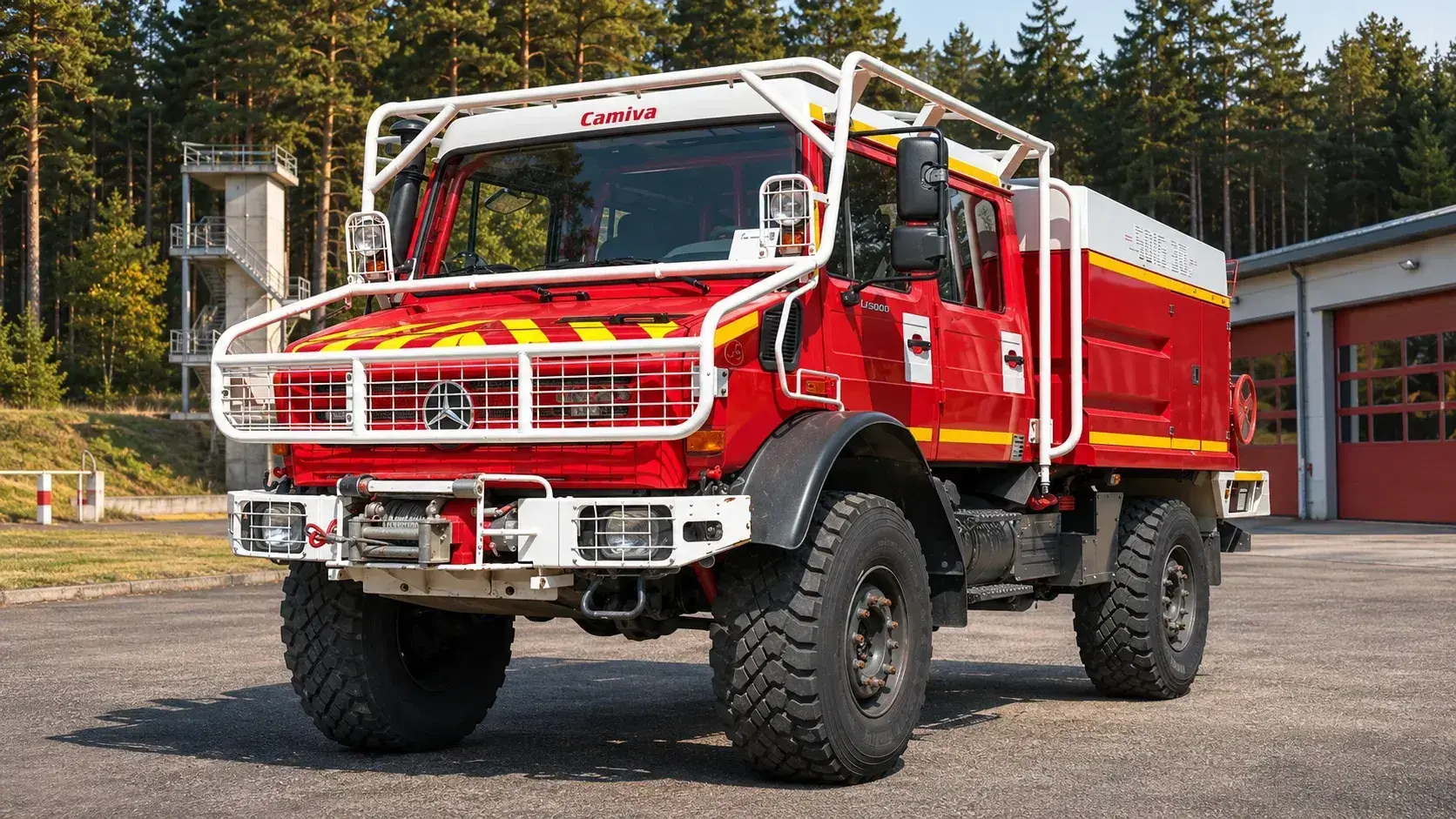
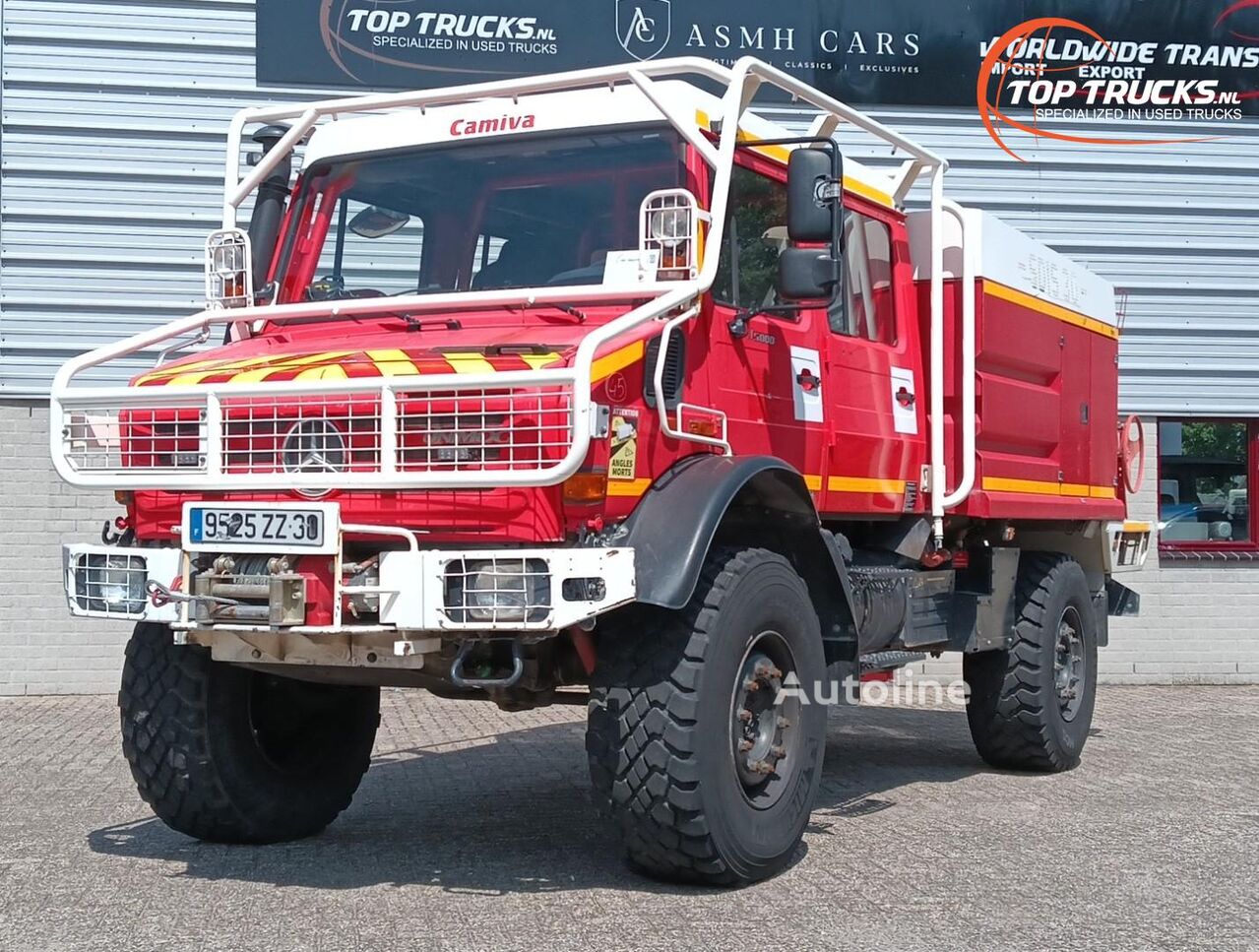
This is not the kind of fire truck that disappears into a row of ordinary road appliances. The tall stance, portal-axle Unimog layout, four-door crew cab and protective external cage immediately point toward difficult-access work. Behind the cab, the seller lists a 4,000-litre water tank, Camiva pump and hydraulic recovery winch.
The live offer describes a 2008 Unimog U 5000 Type 437.4 with 49,144 km, 218 hp, six-speed semiautomatic transmission and 4×4 drive. It is currently located in Dongen, Netherlands, with price available on request.
Confirm whether stock unit TT 4953 remains available and request the seller’s current quotation.
Quick verdict
This U 5000 is worth investigating for a forestry service, rural brigade, industrial emergency team, civil-protection organization or specialist dealer that genuinely needs off-road access. Its advertised tank, pump, crew cab and winch create a capable-looking starting point. The purchase case still depends on verified pump performance, tank and chassis condition, crew-restraint arrangements, 4×4-system operation, documentation, local acceptance and delivered cost.
Listing details at a glance
| Vehicle | Unimog U 5000, Mercedes-Benz Type 437.4 fire truck |
|---|---|
| Year / registration | June 2008 / June 2008 |
| Mileage | 49,144 km |
| Engine | Daimler OM 924 LA diesel |
| Power | 218 hp (160 kW) |
| Emissions | Euro 4; AdBlue listed |
| Transmission | Six-speed semiautomatic |
| Drive / suspension | 4×4 all-wheel drive; coil springs; differential lock |
| Tank | 4,000 litres water, seller stated |
| Pump | Camiva; seller states 2,400 L/min at 3 bar |
| Winch | Hydraulic; seller states 6,000 kg |
| Weights | 8,450 kg net; 14,500 kg gross; 6,050 kg seller-listed payload |
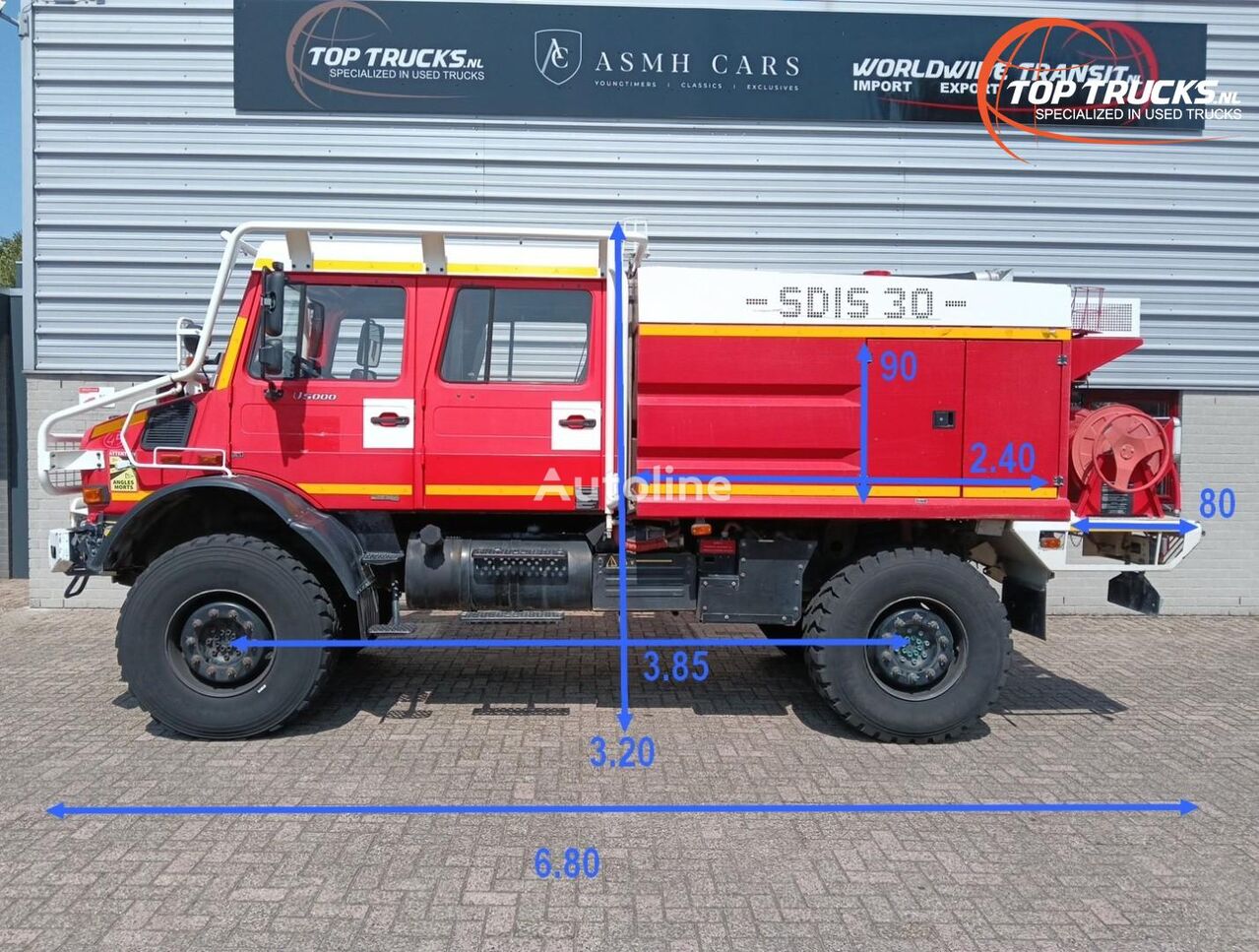
| Dimensions | Approx. 6.80 × 2.45 × 3.20 m |
| Wheelbase / tyres | 3,850 mm / 445/65 R22.5 |
| Tyre profiles | Seller states 50% front and 55% rear |
| Cab | Double cab; exact approved seating capacity to confirm |
| Location | Dongen, Noord-Brabant, Netherlands |
| Price | On request |
| Seller / stock ID | TOP TRUCKS B.V. / TT 4953 |
| Availability | Advertised as available when verified; reconfirm before travel or payment |
What makes the U 5000 different?
A conventional municipal pumper is generally optimized for paved-road response, equipment access and urban water supplies. A water tender prioritises bulk water. A wildland appliance needs mobility, stability and safe access on less predictable terrain. The advertised U 5000 combines a compact fire body with an extreme-off-road chassis, making remote access central to its appeal.
Mercedes-Benz identifies the 437.4 family—including the U 3000, U 4000 and U 5000—as a generation built for difficult terrain. That official history is useful model-family context, not proof that this individual vehicle can meet every terrain, gradient, fording or firefighting requirement. Confirm VIN-specific specifications and define operational limits through testing and risk assessment.
Review the seller photographs and request the pump, tank, winch and bodybuilder records.
Chassis, drivetrain and mobility
The listing states a 218 hp OM 924 LA diesel, six-speed semiautomatic transmission, 4×4 drive, coil-spring suspension, differential lock, disc brakes, ABS, engine brake and cruise control. The 3,850 mm wheelbase and large 445/65 R22.5 tyres contribute to the truck’s distinctive stance.
Do not treat an off-road reputation as a substitute for a route plan. Check portal hubs, axle seals, differential-lock engagement, steering joints, suspension, tyre age and sidewalls, braking, cooling and transmission behaviour. Record the vehicle’s actual height, width, mass, axle loads and turning needs with the tank both empty and full.
Water tank, Camiva pump and hydraulic winch
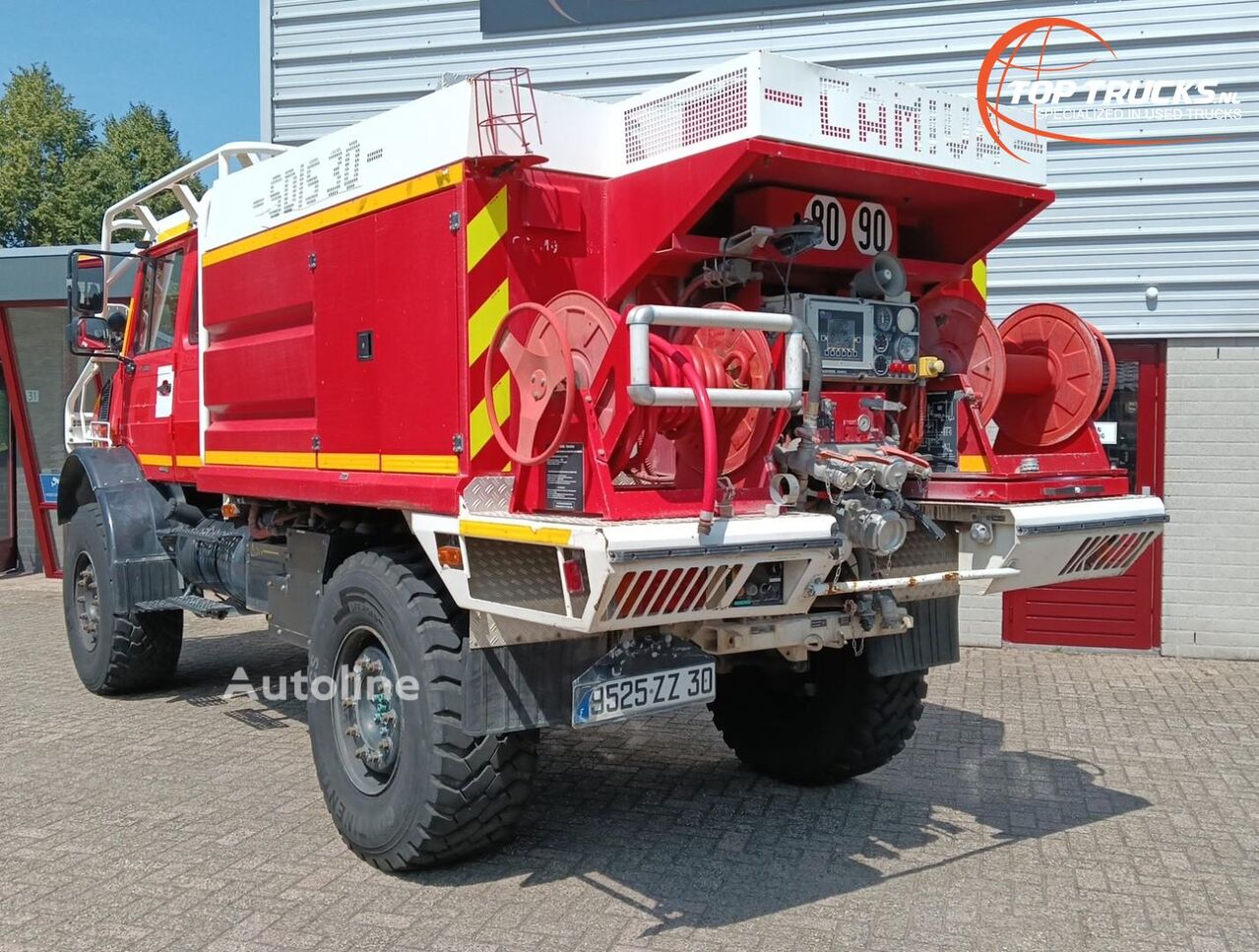
The seller lists a 4,000-litre water tank and Camiva pump rated at 2,400 litres per minute at 3 bar. Because pump ratings can refer to particular test points, request the pump plate, curve, operating manual and latest test certificate. A live demonstration should establish prime, run the outlets under load and show stable pressure without abnormal noise, heat, leakage or vibration.
The advertised 6,000 kg hydraulic winch may be valuable for controlled recovery support, but the figure alone does not define safe working capacity in every direction or setup. Verify the winch make, model, rope condition, fairlead, controls, anchor points, hydraulic system and rated pulling data. Use a documented recovery plan, competent operators and an exclusion zone.
Where this appliance may fit
Subject to testing and local acceptance, the configuration may interest forestry and rural brigades, industrial plants, remote infrastructure operators, civil-protection organizations, disaster-response teams and training centres. Its onboard supply may support an initial attack or remote-area water movement, but 4,000 litres is finite and must be integrated with refill, relay or tanker arrangements.
Match the vehicle to the hazards, terrain, bridges, access tracks, water points, staffing, communications and maintenance capability. A truck that can reach difficult ground still needs safe routes, rollover controls and a dependable exit plan.
Practical HSSE considerations
- Assess route width, overhead clearance, gradients, side slopes, ground bearing capacity and escape options before deployment.
- Account for liquid movement, changing centre of gravity and axle loading as the tank empties.
- Use trained and authorised drivers, pump operators and winch operators.
- Confirm differential-lock engagement and disengagement procedures.
- Control hose-reaction forces and establish safe pump operating zones.
- Keep personnel outside the winch line-of-fire and potential recoil path.
- Isolate hydraulic, pneumatic, electrical and pressurised-water energy before maintenance.
- Use spotters and reliable communications for confined or low-light movements.
- Confirm seating and restraints for every crew member.
- Inspect steps, handholds, walking surfaces and locker doors before travel.
- Plan environmental controls for contaminated water, foam residues, oils and fuel.
- Include the full appliance in drills, preventive maintenance and post-use inspection.
Used fire-truck inspection checklist
Begin with the VIN, registration, ownership, mileage history and chassis build sheet. Inspect the engine cold, transmission, cooling, Euro 4 and AdBlue systems, axles, portal hubs, differential locks, steering, coil springs, brakes, ABS, wheels, tyres and chassis corrosion.
On the body, inspect tank mountings, baffles, internal condition, pipework, valves, level indication, pump plate, PTO, priming system, gauges, outlets, controls and leaks. Examine the hydraulic winch, rope, fairlead, anchors and controls. Verify emergency lighting, cab restraints, equipment lockers, manuals and parts support. Finish with an independent inspection, cold start, road test, live pumping test, 4×4-system check and controlled winch demonstration.
Price, availability and equipment inventory can change after publication.
Product Location: Dongen, Netherlands
The live listing places the truck in Dongen, Noord-Brabant, with the seller address shown as Berlagestraat 31, 5103 MA Dongen. Confirm the exact inspection and collection point before travelling. Ask whether the truck remains on site, whether a road test is allowed, whether a water source is available for a pump test and what loading support can be provided.
Shipping, export and delivery
TOP TRUCKS handles international enquiries, but the listing does not publish a vehicle-specific destination list, fixed delivery charge or included freight service. Do not assume worldwide door-to-door delivery.
Request a written quotation covering the vehicle price, VAT treatment, export registration, inspection, loading, inland transport, port handling, sea freight, insurance, customs documents, import duties, destination charges, offloading, local registration, pump testing and commissioning. Ask for the applicable Incoterm and the exact transfer point for cost and risk.
Ask for export documents, loading arrangements and a written destination quotation.
Current Seller Offer — Verified 7 November 2026
Advertised price: On request
Status: Listed as available
Seller: TOP TRUCKS B.V.
Seller stock ID: TT 4953
Marketplace reference: RR51581
Location: Dongen, Noord-Brabant, Netherlands
Headline facts: 2008, 49,144 km, 218 hp, 4×4, 4,000-litre tank, Camiva pump and seller-listed 6,000 kg hydraulic winch
No vehicle-specific fixed delivery charge, destination list or warranty was published in the offer reviewed. Availability and commercial terms can change, so obtain a dated written quotation.
Exact seller video
TOP TRUCKS published a 15-second video of stock unit 4953 on 10 July 2026. It shows the exact advertised vehicle and is embedded from YouTube using the privacy-enhanced domain.
View the seller’s video on YouTube ↗
Questions to ask TOP TRUCKS
- Is stock unit TT 4953 still available?
- What is the current asking price and VAT status?
- Can you provide the VIN, registration and ownership documents?
- Is the 49,144 km mileage supported by records?
- How many approved seats and serviceable restraints are fitted?
- What is the complete engine and transmission service history?
- Do all differential locks and off-road systems operate correctly?
- What work has been completed on the portal hubs and axle seals?
- What is the tank material, usable capacity and internal condition?
- Are tank-baffle drawings or inspection records available?
- What is the Camiva pump’s exact model and serial number?
- What test evidence supports 2,400 L/min at 3 bar?
- When was the pump last serviced and performance-tested?
- What is the PTO’s condition and operating history?
- What is the hydraulic winch make, model and rated capacity?
- What is the winch rope’s age, condition and inspection status?
- Which hoses, branches, ladders, tools and loose equipment are included?
- Are all beacons, alarms, work lights and radios operational?
- Are there water, hydraulic, oil, coolant, air or fuel leaks?
- Has the chassis, cage, tank or fire body had structural repairs?
- Are operating, workshop, pump and bodybuilder manuals included?
- Can an independent Unimog and fire-appliance inspection be arranged?
- Can the truck be demonstrated from a cold start and road-tested?
- Can the pump, 4×4 systems and winch be demonstrated safely?
- What export documents, loading and delivery support are available?
- What deposit protection, payment, warranty or return terms apply?
Frequently asked questions
What is the Unimog U 5000 fire truck used for?
Its off-road chassis, water tank, pump and winch make it a candidate for rural, forestry, industrial and remote-area emergency work, subject to inspection and local acceptance.
How much water does it carry?
The seller lists a 4,000-litre tank. Confirm usable capacity, construction, baffles and condition.
Is it four-wheel drive?
Yes. The listing describes 4×4 all-wheel drive with differential locking.
What pump is fitted?
The seller identifies a Camiva pump and states 2,400 litres per minute at 3 bar. Verify the pump plate, curve and test results.
Does it have a winch?
The seller states that a hydraulic winch rated at 6,000 kg is fitted.
Where is the truck located?
Dongen, Noord-Brabant, Netherlands. Confirm the precise inspection and collection point.
Is the asking price published?
No. The price is listed on request.
Can it be exported?
The seller accepts international enquiries, but destination-specific export and freight terms must be obtained in writing.
Is it suitable for forestry firefighting?
Potentially, but suitability depends on verified vehicle capability, routes, water strategy, crew competency and local requirements.
What should buyers inspect?
Inspect the chassis, engine, transmission, portal hubs, brakes, tyres, tank, pump, PTO, winch, body, electrical systems and documentation.
Should the pump be tested?
Yes. Request a documented live pumping demonstration and current performance evidence.
Should buyers request a live demonstration?
Yes. Include a cold start, road test, pump test, 4×4-system check and controlled winch demonstration.
Final assessment
This 2008 Unimog U 5000 combines a serious off-road chassis with a useful-looking firefighting package: crew cab, 4,000-litre tank, Camiva pump and hydraulic winch. Those features make it interesting, but they do not remove the need for disciplined due diligence. Move forward only when the documentation, chassis and portal hubs, tank, pump, winch, safety systems, local acceptance and delivered cost all support the intended mission.
Use the live offer to confirm the records, pump test, winch status and inspection access.
Continue the discussion
Would a 4×4 Unimog fire truck improve access to remote or difficult terrain in your operation? Share your intended application or inspection questions in the comment section below.
Sources and verification notes
- Live TOP TRUCKS marketplace offer — seller-stated year, mileage, configuration, location and firefighting equipment; verified 7 November 2026.
- Mercedes-Benz Special Trucks: Unimog 437.4 history — official extreme-off-road model-family context.
- Mercedes-Benz Special Trucks: U 5000 technical overview — official model-family dimensions and configuration context.
- TOP TRUCKS: stock 4953 Unimog U 5000 video — seller video published 10 July 2026.
Your experience matters
Share your thoughts on this page
Have a question, a useful experience or a suggestion? Add your input below.
Comments are public. Keep them respectful and relevant. Do not share contact details, confidential information or emergency reports.
Comments on this page
Loading comments…