HSSE TIPS · Product Reviews · Neonatal Transport / Specialist Ambulances
Toyota Neonatal Ambulance Review: Transport Equipment, Specifications & Buying Guide
Introduction — Planning Specialized Transport for Newborns
A neonatal transfer begins before an ambulance leaves the hospital. The receiving team needs the right information, the transport team needs a workable equipment package, and the vehicle must accommodate that package throughout loading, travel and handover.
For a purchasing team, the central question is how those parts work together. An incubator, a trolley and a vehicle are individual products; a neonatal transport service needs an accepted installation, trained people and a defined operating plan.
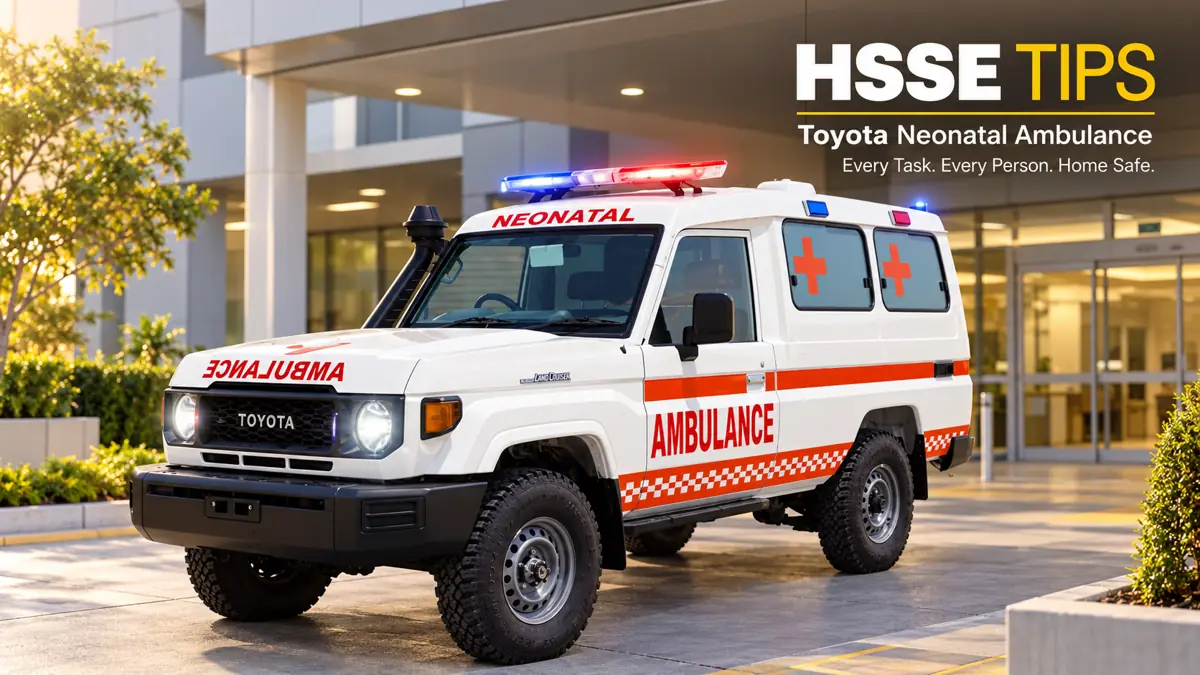
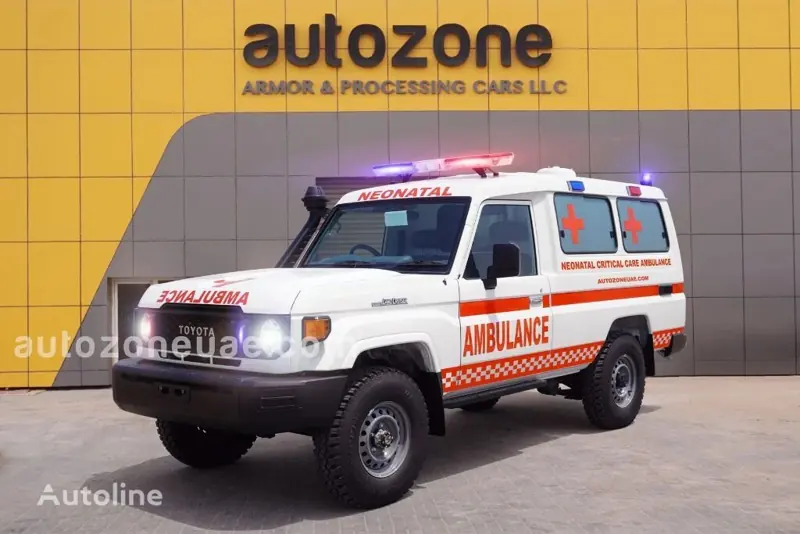
The Toyota Neonatal Ambulance advertised by Autozone UAE provides a specific conversion to investigate. Original photographs show a Land Cruiser-style hardtop exterior and a patient compartment containing an incubator assembly, storage, seating and medical-gas cylinders. This review examines the published offer and the integration questions institutional buyers should resolve before acceptance.
Affiliate Disclosure: Worksite Safety Hub may earn a commission if you make a qualifying purchase through links in this article. This does not change the price you pay.
EXPLORE THE TOYOTA NEONATAL AMBULANCE
Toyota Neonatal Ambulance Overview
The reviewed product is a neonatal transport conversion, rather than a general consultation clinic or maternity workspace. Its advertised purpose concerns newborn transport, with respiratory, monitoring and other equipment described in the seller’s schedule.
That schedule is a starting point for a detailed enquiry. Buyers should establish the exact items supplied, their condition, intended patient population and installation documentation. The article does not treat the seller’s “mobile neonatal ICU” description as proof of equivalence to a hospital intensive care unit.
Assess the proposed build with the service’s clinical lead, biomedical engineering team and fleet personnel. Their combined review connects clinical requirements to equipment compatibility, vehicle loads and practical ownership support.
Understanding the Toyota Platform and Chassis
Autozone UAE identifies its corresponding product as a Toyota Land Cruiser neonatal ambulance with an HZJ78 designation. The exact offered vehicle still needs VIN-linked chassis and conversion records. Those establish the applicable Toyota specification and destination-market documents.
The published description contains “V6” wording. Toyota’s historical HZ engine-family information describes an in-line six-cylinder layout. This is a documentary discrepancy to reconcile with the actual engine identification; it is not a basis for silently changing the advertisement or assigning an uninspected engine code.
Request manufacturer records, registration documents and the completed conversion’s drawings. Do not transfer dimensions, safety features or payload from another Land Cruiser version simply because the exterior looks similar.
Engine, Transmission and Four-Wheel-Drive Configuration
The advertised powertrain and geometry are summarized in the table below. Their relevance is the intended duty: route access, travel distance, driver competence, maintenance and the loads carried on an actual transfer.
Four-wheel drive describes the vehicle configuration. It does not establish that every rough route is suitable for an incubator installation or a particular patient. Route selection belongs to the service’s clinical and operational assessment, supported by the equipment’s transport requirements.
Request completed-vehicle weight and axle-loading evidence with the proposed equipment, gas, consumables and people accounted for. Agree maintenance support and parts availability at the destination. The review adopts no verified fuel consumption, ride-comfort score or operating payload.
Patient Compartment and Equipment Layout
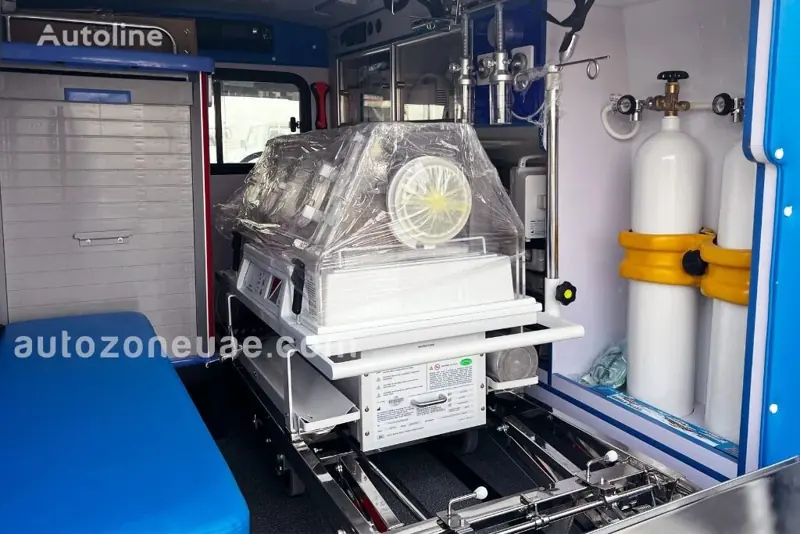
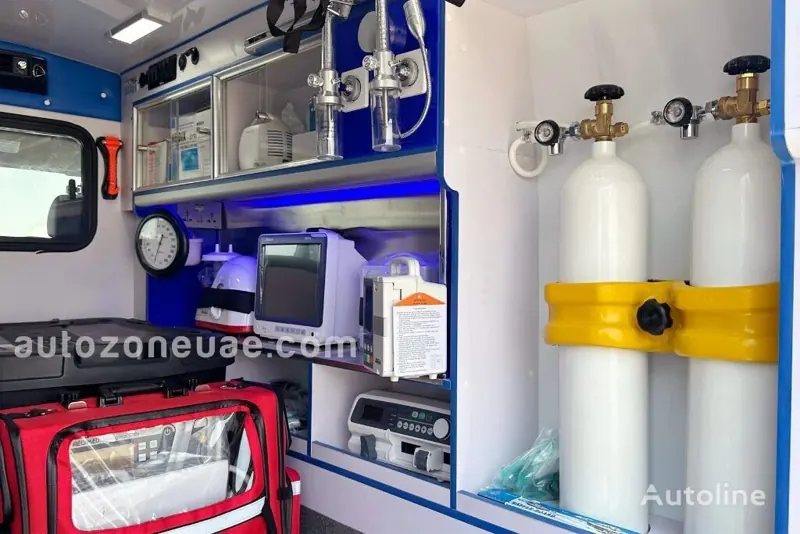
The gallery shows blue-and-white furnishings, a central incubator arrangement, a bench, cabinets and a cylinder installation. These are useful visual references for discussing reach, access and storage; they do not establish an approved seating or working-capacity specification.
Ask for a scaled drawing showing the occupied positions, loading path, clearances and service access. Demonstrate how staff reach essential controls while using the approved restraint arrangements. Include access to shutoffs and emergency exits in the review.
Identify where clean supplies, used equipment and records will be kept. Cabinet latches, mounting points and working clearances should be assessed on the finished build rather than assumed from photographs.
Transport Incubator, Trolley and Loading System
An incubator assembly on a support/loading arrangement is visible in the original photographs. Its manufacturer, exact model, service status and accepted transport accessories require documentary confirmation. Protective wrapping and a display appearance do not establish operational readiness.
Treat the incubator, trolley, loading mechanism, floor attachment and vehicle structure as one installation. Obtain compatibility statements, operating instructions, permitted loads and the applicable installation and transport evidence for the specific combination.
Request a demonstration of loading, locking, release and recovery using the agreed handling procedure and trained personnel. Check clearances with cables, tubing and accessories routed as intended. Vehicle air conditioning and incubator thermal control serve different functions and need separate acceptance criteria.
Respiratory Equipment and Medical-Gas Provision
The seller describes a respiratory package, but the final device identities and instructions must establish suitability for the intended neonatal service. Do not infer a ventilator’s patient range or transport authorization from the advertisement’s wording alone.
The published name Shangrila 510S needs reconciliation with the supplied unit’s label, manufacturer instructions, accessories and approved patient population. A model name in an equipment list is not enough to establish neonatal application in this installation.
Likewise, an oxygen analyzer measures a characteristic of the gas supply, while a blender serves a different function. Confirm both proposed items and their compatibility rather than treating the names as interchangeable.
The photographs show two secured cylinders and associated fittings. Gas identity, cylinder capacity, inspection status, regulators, connections and usable endurance need records and an agreed operating scenario. Include expected consumption, reserve arrangements and backup responsibilities in the specification; no endurance figure is established here.
Monitoring, Suction and Infusion Equipment
The monitoring package should identify the device, measured parameters, neonatal sensors, accessories, alarms and support arrangements. The seller’s “five parameters” wording does not identify which measurements are supplied. An end-tidal CO₂ detector should not be presented as continuous capnography without appropriate documentation.
The advertised AV 500X name has a corresponding AV-500X syringe-pump page from Aveus Instruments. That corroborates a model designation, not the identity or neonatal transport suitability of a device supplied with this ambulance. Obtain the actual label and instructions before adopting any manufacturer performance figures.
The list also uses the Neopuff name; Fisher & Paykel Healthcare identifies Neopuff as an infant T-piece resuscitator. Confirm the exact supplied configuration, required gas source, accessories and approved use with the clinical team. No treatment settings or clinical operating instructions are provided in this review.
DISCOVER THE NEONATAL TRANSPORT EQUIPMENT
Electrical Power and Operating Continuity
Prepare a device-by-device power schedule. Identify the equipment operating simultaneously, any starting demand, charging needs and the activities requiring continuity through each stage of a transfer.
Battery capacity, inverter output, outlet ratings and external-supply arrangements were not established for the offered build. Ask the supplier to document them and demonstrate the accepted configuration. A device’s internal battery rating does not automatically establish the endurance of the whole transport system.
Plan what happens during loading, disconnection from hospital supply, travel and handover. Confirm approved changeover, charging and shutdown procedures, with qualified electrical assessment of protection, isolation and connections. Agree how staff recognize and respond to a supply interruption.
Climate Control, Cleaning and Infection Prevention
Assess compartment cooling and ventilation against the destination climate, occupancy and equipment heat. Separately confirm the incubator’s operating requirements and the environmental conditions specified for each medical device.
Obtain interior material details and cleaning compatibility. CDC’s core infection-prevention guidance supports documented cleaning and reusable-equipment reprocessing following manufacturer instructions. Include access around mounts, storage and high-touch surfaces in the acceptance inspection.
Agree responsibilities for cleaning, waste handling, restocking and return to service. Distinguish environmental cleaning from device-specific processing, and separate clean supplies from used items. Neither a finished interior nor a general material claim establishes an infection-control certification.
Technical Specifications and Equipment Tables
Vehicle and Conversion Specifications
These are seller/converter entries, not a VIN-verified engineering specification.
| Specification | Published Information | Buyer Confirmation Needed |
|---|---|---|
| Advertised platform | Toyota Land Cruiser / HZJ78 designation | VIN, model code, engine identity and market variant |
| Engine / gearbox / drive | 4,200 cm³ diesel / manual / 4×4 | Chassis-specific records and gear count |
| Dimensions / wheelbase | 5,140 × 1,800 × 2,115 mm / 2,980 mm | Completed-vehicle measurements and accessory scope |
| Output entries | 96 kW at 3,800 rpm; 285 Nm at 2,200 rpm | Applicable manufacturer data and offered engine |
| Fuel / steering | 90-litre fuel capacity; converter describes LHD | Actual specification; no operating range inferred |
| Brakes / suspension | ABS and coil-spring field listed | Axle-specific construction and completed configuration |
| Seating | Marketplace field states five | Approved travel seating, restraints and loading arrangement; not infant capacity |
| Weight and payload | Not specified in the information reviewed | Gross/axle limits, completed weight and remaining allowance |
| Cylinder-layout wording | Seller says V6; Toyota HZ family reference says in-line six | Reconcile using the offered engine’s identification |
Neonatal Transport Equipment
| Equipment | Evidence Status | Procurement Relevance |
|---|---|---|
| Incubator and loading arrangement | Advertised and pictured | Confirm model, compatibility, mounting and handling evidence |
| Ventilator / CPAP | Seller-described package | Verify patient range, transport use and accessories |
| Oxygen analyzer / blender | Advertised | Confirm separate devices, compatibility and supporting gas supply |
| Monitor / neonatal pulse-oximetry probe | Advertised; monitor visible | Establish parameters, sensors and alarm functions |
| End-tidal CO₂ detector | Advertised | Identify method; do not assume continuous capnography |
| Suction units | Several forms described | Confirm actual inventory and intended applications |
| Infusion / syringe pumps | Advertised; AV 500X name used | Match device identity, accessories and clinical requirements |
| T-piece / bag-mask resuscitation items | Advertised; Neopuff name used | Obtain accepted inventory and manufacturer instructions |
| Gas cylinders and fittings | Two-cylinder installation pictured | Establish contents, capacity, restraints and inspection status |
| Other accessories / fire equipment | Seller lists additional airway, examination and emergency items | Require quantities, expiry/service status and destination suitability |
| Batteries / external power | Build-specific ratings not established | Agree complete supply and continuity demonstration |
VIEW CURRENT PRICE & AVAILABILITY
Neonatal Transport Applications and Service Planning
Hospital and Regional Transfer Networks
A suitably specified ambulance may form part of a hospital-to-hospital neonatal transport service. Define referral arrangements, clinical responsibility, receiving-facility communication and handover before selecting the vehicle package.
NHS England’s published neonatal transport specification provides an England-specific planning reference for coordinated specialist services. It is not evidence that this vehicle meets NHS requirements or the rules of another country.
Maternity Referral and Specialist Fleets
Services supporting maternity facilities should distinguish newborn transfer from maternal transport and other ambulance roles. Match the proposed team and equipment to the accepted neonatal service scope. Do not infer a combined maternity clinic from this conversion.
Humanitarian and Dispersed Healthcare Programs
Assess referral destinations, journey conditions, communications, replenishment and maintenance support before choosing the build. Suitability depends on local approvals and a trained service, not the presence of four-wheel drive or an equipment list alone.
Crew Safety, Restraints and Equipment Security
Specify approved travel seating and restraint arrangements for everyone carried. The ability to reach equipment while appropriately restrained should be demonstrated with the final layout, including visibility of essential displays and access to controls.
Obtain installation evidence for the incubator support, gas-cylinder restraints, cabinets and device mounts. Check permitted loads and maintenance instructions. A visible rail, strap or bracket does not establish crash-test performance for the complete assembly.
Plan loading and unloading around the actual handling equipment, site geometry and trained crew. Keep exits usable, secure loose supplies and agree checks before movement. Certification claims should identify the issuing body, document, scope and exact installation covered.
Deployment, Maintenance and Commissioning
Review proposed routes and hospital access points, including parking, gradients, thresholds and loading space. Confirm completed dimensions and axle loads with the full operational equipment package rather than an empty demonstration vehicle.
Commission the vehicle and medical systems together. Agree demonstrations covering loading, restraints, power, gas, alarms and maintenance access, with clinical and engineering personnel involved. Record acceptance criteria and outstanding actions in the handover documents.
Arrange local servicing for both chassis and devices, including consumables, calibration where applicable, batteries and replacement parts. Define training, familiarization, service records and a process for authorizing the unit’s return after maintenance.
Current Seller Offer — Verified 26 October 2026
Verification means checking the published advertisement, converter information and affiliate redirect on this date. No physical inspection, seller contact, equipment test, clinical assessment or confirmation of ready stock was performed.
| Offer Detail | Information Reviewed |
|---|---|
| Exact product / reference | Toyota Neonatal Ambulance / Autoline TE43209 |
| Advertised chassis | HZJ78 designation; corresponding converter page identifies Land Cruiser |
| Year / first registration / condition | 2025 / 2025 / new — advertiser entries |
| Mileage | Not specified in the information reviewed |
| Asking price | On request |
| Product location | Ajman, United Arab Emirates, from the product-location field |
| Offered package | Seller-described equipment above; unit-specific inventory and compatibility documents required |
| Availability / lead time | Advertisement accessible; stock allocation and production status not confirmed |
| Delivery / export | Vehicle-specific destinations, collection, freight, insurance and Incoterms not specified |
| Commissioning / support | Product-specific training, warranty and after-sales terms require confirmation |
This is the new TE43209 offer; the separate used advertisement XU43956 is not the source for its condition or specifications.
Delivery destinations, shipping arrangements, and applicable transport terms were not specified in the information reviewed. Prospective buyers should confirm these details directly with the seller.
The supplier’s general export statements do not establish this order’s terms. Request written responsibilities for freight, insurance, export documents, customs, registration and medical-device requirements at the destination.
CHECK SHIPPING & EXPORT OPTIONS
What Buyers Should Confirm Before Purchasing
Prepare a service brief covering intended patients, transfer routes, staffing, equipment and receiving facilities. Ask the quotation to connect that brief to one identified finished build.
- Vehicle: VIN, manufacturer records, completed dimensions, axle loads and remaining payload.
- Integration: Incubator, trolley, floor attachments, gas installation, device mounts and approved seating.
- Medical inventory: Exact makes, models, accessories, patient applicability, manuals and support.
- Continuity: Accepted electrical loads, gas scenario, reserves, changeover and interruption arrangements.
- Acceptance: Demonstrations, documentation, qualified sign-off, training and maintenance responsibilities.
- Commercial terms: Inclusions, stock, lead time, price, delivery, warranty and destination support.
Include the full service in ownership planning: staff, consumables, maintenance, training and backup arrangements. No financial-return estimate, clinical-outcome guarantee or universal registration eligibility is established by the advertisement.
Frequently Asked Questions
What is this ambulance intended to support?
Specialized newborn transport, subject to the accepted equipment, trained team, operating procedures and applicable authorization.
Is it based on a Toyota Land Cruiser?
The corresponding converter page identifies a Land Cruiser HZJ78. Confirm the exact chassis and engine through VIN-linked records.
Are the incubator and loading system included?
They are described and an assembly is pictured. Obtain the contractual inventory, exact models and compatibility documentation.
Does the advertised ventilator establish neonatal suitability?
No. Confirm the supplied model’s intended patient population, accessories and transport use from its manufacturer instructions and clinical assessment.
What monitoring is supplied?
The listing describes a monitor and neonatal pulse-oximetry provision. Exact parameters, sensors, alarms and CO₂ equipment need confirmation.
How long will the oxygen supply last?
No verified endurance is available. Establish the accepted cylinder capacities, device demand, reserves and operating scenario.
What electrical backup is provided?
Build-specific battery and supply ratings were not established. Request diagrams and a demonstration with the agreed equipment operating.
How many patients or attendants can travel?
The marketplace seating entry does not establish neonatal patient capacity. Obtain the approved occupied layout and restraint documentation.
What cleaning and maintenance arrangements are needed?
Agree device-specific instructions, interior cleaning compatibility, service support and responsibilities before commissioning.
Is specialist staffing and training required?
The service needs personnel qualified for its intended neonatal work, together with training and familiarization for the actual vehicle and equipment.
What are the price, location and stock status?
The reviewed offer lists price on request and Ajman, United Arab Emirates. Confirm a current quotation and availability of the exact build.
Can it be exported and registered locally?
Vehicle-specific shipping and destination eligibility were not established. Confirm transport terms, chassis documents and medical-device requirements for the intended country.
Final Verdict
The Toyota Neonatal Ambulance provides a photographed conversion and a seller-described equipment package for institutional evaluation. The incubator arrangement, storage and gas installation make integration discussions concrete.
The purchasing decision should rest on the finished system: identified chassis, accepted device inventory, documented mounting, suitable supplies and an appropriately staffed service. Confirm those elements together before accepting the commercial offer.
For a separate ambulance configuration, see our Toyota Land Cruiser LC78 Ambulance review. Its equipment and specifications must not be transferred to this Toyota conversion. Explore more Product Reviews for institutional purchasing guidance.
Sources and Editorial Method
Reviewed on 26 October 2026: the exact affiliate-linked Autoline TE43209 advertisement, corresponding Autozone UAE Toyota Land Cruiser Neonatal Ambulance page and seven-image product gallery. Seller reports, visual observations and original purchasing analysis are distinguished. No physical inspection, device test or seller contact is claimed.
- Toyota: HZ engine-family history — historical cylinder-layout context, not VIN confirmation.
- Aveus Instruments: AV-500X — model-reference context, not proof of the supplied unit.
- Fisher & Paykel Healthcare: Neopuff — product-family identification; no clinical settings adopted.
- NHS England: neonatal transport specification — England-specific published service-planning context, not vehicle approval.
- CDC: core infection-prevention practices — general cleaning and equipment-reprocessing context.
Advertiser photographs are reproduced under the publisher’s recorded permission, with watermarks retained. The featured image is separately captioned editorial artwork. No product-specific advertiser video was verified. This is procurement information, not clinical treatment guidance.
Join the Conversation
When specifying a neonatal ambulance, which integration requirement would your team prioritize—incubator loading, equipment security, power continuity or medical-gas provision? Share your procurement priorities and professional experiences in the comments below. Please do not include identifiable patient information.
Your experience matters
Share your thoughts on this page
Have a question, a useful experience or a suggestion? Add your input below.
Comments are public. Keep them respectful and relevant. Do not share contact details, confidential information or emergency reports.
Comments on this page
Loading comments…