HSSE TIPS · Product Reviews · Mobile Workshops / Field Maintenance Vehicles
Toyota 4×4 Mobile Workshop Truck Review: Equipment, Specifications & Buying Guide
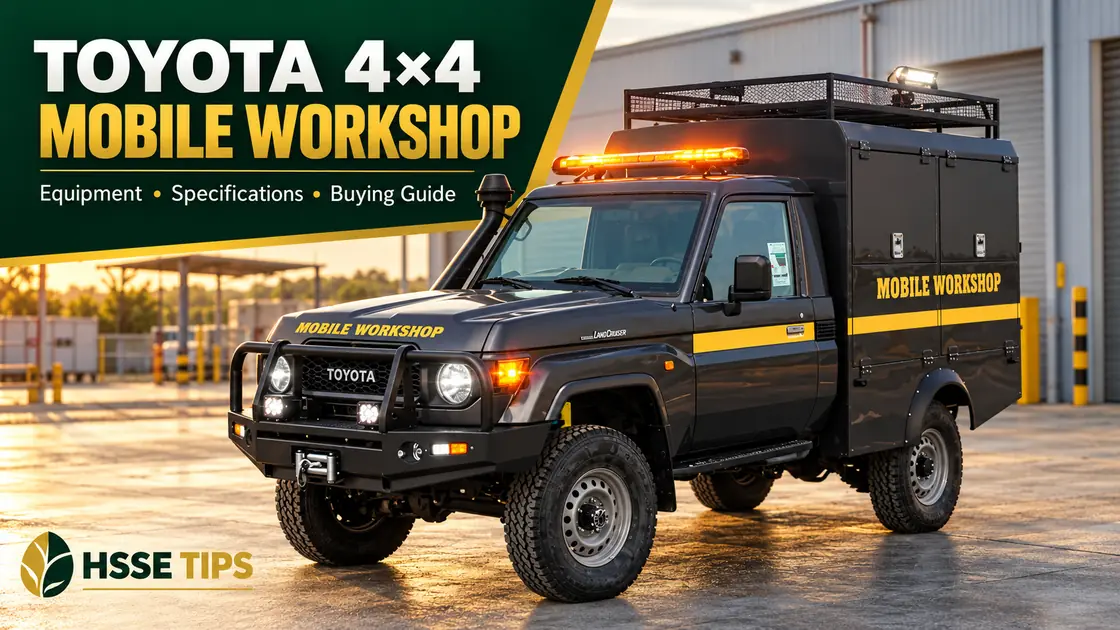
Introduction — Bringing Maintenance Support Closer to the Job
A field-service call begins before the technician reaches the machine. The right tools need to travel securely, the working location needs to be suitable, and the vehicle must carry everything within its permitted loads. A well-specified mobile workshop brings those decisions together.
The Toyota 4×4 Mobile Workshop is advertised as a specialist service vehicle with organized equipment storage and workshop utilities. Its original gallery shows a dark single-cab truck, a tall compartment body, roof storage and accessible tool areas. For maintenance teams, the purchasing opportunity lies in matching that layout to a defined set of jobs.
This review examines the published specification and gallery, then develops practical buying checks. It is a document-based assessment, with no inspection, road test or equipment trial. Several chassis and engine details require reconciliation before the vehicle can be specified confidently.
Affiliate Disclosure: Worksite Safety Hub may earn a commission if you make a qualifying purchase through links in this article. This does not change the price you pay.
EXPLORE THE TOYOTA 4×4 MOBILE WORKSHOP
Toyota 4×4 Mobile Workshop Overview
The advertised concept combines a Toyota four-wheel-drive vehicle with a workshop conversion carrying selected tools and support equipment. The gallery gives useful insight into exterior access, drawers and utility compartments. It does not establish the identity, rating or contractual inclusion of every photographed device.
Treat the published equipment list as a basis for an agreed procurement schedule. Define what arrives with the truck, what is selected separately and what the operator must provide. Link that schedule to a layout drawing, a weight report and the quotation, so the vehicle and its equipment can be assessed as one package.
This review covers Autoline JZ42462. It is not the separate Toyota Land Cruiser Mobile Workshop Van advertisement, and it does not borrow that vehicle’s specifications or equipment. The listing reference is useful when asking the seller to identify the exact offered build.

Understanding the Toyota Platform and Chassis
The corresponding converter page identifies HZJ79, but its engine block also contains 4.5-litre and V6 wording. These entries need to be reconciled through the VIN, chassis plate and engine code. This review does not adopt them together as an established Toyota specification.
Toyota Gibraltar Stockholdings’ 70 Series brochure provides family context for HZJ79 and the 1HZ 4.2-litre six-cylinder diesel. That context helps identify the question; it does not prove which engine is installed in this offered conversion. The published power and torque figures should likewise be checked against actual vehicle records rather than used to infer an engine.
Request the exact market variant, year, registration and conversion documents. The single-cab gallery presentation also needs to be reconciled with the published six-seat field. Neither a photograph nor a marketplace field establishes approved occupant positions for the delivered vehicle.
Engine, Transmission and Four-Wheel Drive
Diesel fuel and manual transmission are advertiser-reported. The description refers to part-time manual four-wheel drive and differential locking. Confirm the actual gearbox, transfer case and differential specification, together with the applicable Toyota owner’s manual and operating restrictions.
Match the drivetrain to routes, load and recovery arrangements. Four-wheel drive does not establish unrestricted access, hazardous-area suitability or underground mine approval. Route selection and a suitable working area remain part of the operator’s service plan.
Vehicle fuel capacity is published as 130 litres, but its applicability requires confirmation. A separate reference to a tank with a pump must be identified independently: ask whether it concerns the vehicle fuel system, a dispensing tank or another installation. Do not convert fuel capacity into a promised service range or equipment runtime.
Workshop Conversion, Storage and Equipment Access
The photographs show a tall service body with large side openings and equipment arranged in separate compartments. Obtain a dimensioned drawing covering doors, opening clearances, working heights and access to heavier items. Include the space needed beside the parked truck, not just its closed-body dimensions.
Confirm construction materials, subframe attachment, door supports, locks, seals and equipment restraints. Reflective or patterned finishes do not establish a particular material grade, load rating or protection classification. Ask for the actual finish and maintenance schedule.
The roof rack and rear access arrangement are visible in the gallery and referenced in the equipment text. Request permitted loading, travel height and the approved means of access. A rack’s dimensions do not establish how much weight it can carry, or whether it may be used as a working platform.
Workbench, Vice and Tool Organization
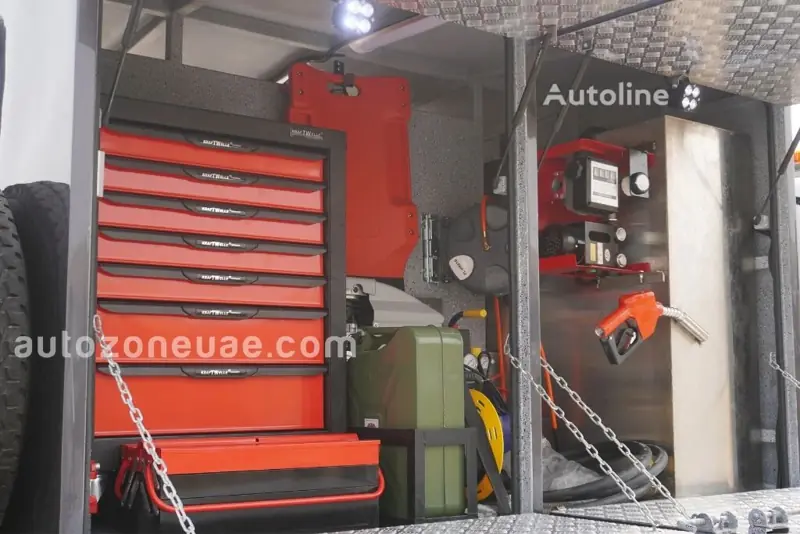
A bench vice, drawer tool trolley and hand tools appear in the advertised list. The gallery shows red drawers and organized storage. Ask for usable dimensions, drawer retention, vice mounting and an itemized tool inventory rather than relying on descriptions such as “full set.”
Design the storage around the technician’s workflow. Frequently used tools should have defined positions, while measuring instruments, chemicals, spares and personal items need appropriate separation. Confirm which equipment stays attached during use and which items are removed and set up outside.
Review how every portable item is restrained for travel. Drawer locks, tie-downs and brackets should be part of the handover inspection. Organized storage is most useful when the team can inventory the contents and return equipment to an agreed transport position after each job.
Air Compressor, Hose Reels and Pneumatic Tools
An air compressor and hose reels are advertised. Request the compressor manufacturer, model, delivered airflow at the required pressure, receiver details, duty cycle and inspection documentation. Compressor displacement alone does not establish usable air delivery to a tool.
Confirm hose ratings, length, couplings, reel retention and the operating position of the equipment. Select pneumatic tools against their actual air requirements and planned duty. The presence of a compressor does not show that all tools can run together or that the air is suitable for breathing equipment.
Generator and Electrical Systems
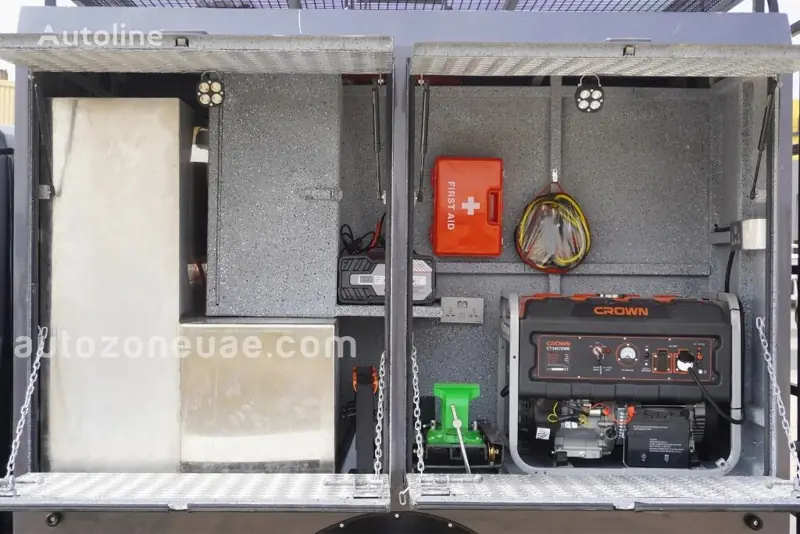
The description lists a 7 kVA generator, but the final generator identity and nameplate must be checked against the offered build. Obtain continuous and maximum ratings, voltage, frequency, fuel and manufacturer documentation. The gallery’s generator photograph should support identification, not substitute for it.
Apparent power in kVA is not automatically equal to usable real power in kW. Ask for the relevant power factor and a load schedule covering tools, lighting and starting demand. The term “silent” in advertising does not establish a measured noise level or test condition.
External supply, batteries, charging, inverter capacity, sockets, protection, earthing and changeover arrangements need separate confirmation. Define which systems power each device. No operating duration or simultaneous-tool capability is established by the information reviewed.
Battery Service, Lubrication and Workshop Tools
Battery charging, jump-start accessories, grease tools, measuring tools, welding, drilling and cutting equipment are referenced in the published list. Their exact identities, accessories and inclusion need an itemized quotation. Unclear tool names should be clarified rather than expanded into unsupported functions.
Match chargers and starting aids to the intended battery chemistry and voltage. Confirm instrument ratings and calibration needs for the tasks. A generic multimeter does not establish suitability for high-voltage vehicle work, and a welding-machine entry does not define a supported welding process or duty cycle.
Where fluids are carried or dispensed, agree tank contents, materials, capacity, pumping, hose identification and transport requirements. Specify used-fluid collection and spill containment separately. A fuel or grease-system mention does not establish a complete oil-change or waste-recovery package.
Recovery Equipment and Vehicle Support Accessories
The accessory list includes recovery equipment, a winch, jacking equipment and stands. Confirm each component’s manufacturer, model, rating, compatibility and inspection requirements. The presence of a front winch in a photograph does not establish its capacity, condition or supply inclusion.
Vehicle recovery, supporting a vehicle for maintenance and lifting people are different tasks. Specify equipment for its documented intended use. Do not infer personnel-lifting capability from a winch or a safe maintenance support arrangement from a jack alone.
Ask how recovery accessories, jacks, boards and other loose equipment are stored and restrained. Confirm any suspension or brake changes through installation and approval documents. Broad “heavy-duty” wording is not a technical rating or evidence of an upgraded system.
DISCOVER THE WORKSHOP EQUIPMENT & STORAGE
Technical Specifications and Equipment Tables
| Specification | Published Information | Buyer Confirmation Needed |
|---|---|---|
| Identity | Toyota 4X4 Mobile workshop; converter identifies HZJ79 | VIN, exact chassis, year and market variant |
| Engine | Sources combine HZJ79, 4.5-litre and V6 wording | Engine code and applicable Toyota records; no combined specification adopted |
| Fuel / transmission | Diesel and manual advertised | Actual engine, gearbox and gear count |
| Drivetrain / steering | Part-time 4×4 and LHD described | Transfer case, differential locks and applicable manual |
| Gross weight | 3,200 kg published | Actual vehicle rating; not payload |
| Completed weight / payload | Not specified in the information reviewed. | Weighed axle loads and remaining capacity after conversion |
| Seating | Six seats published; gallery shows single-cab presentation | Approved seating and restraints in actual vehicle records |
| Fuel capacity | 130 litres published; pump/tank also referenced | Vehicle fuel versus separate dispensing system |
| Ground clearance | 235 mm published | Applicability to actual loaded conversion |
| Dimensions / wheelbase / year | Not specified in the information reviewed. | Completed dimensions, travel height, access and registration records |
| Equipment | Evidence Status | Procurement Relevance |
|---|---|---|
| Drawers / workbench / vice | Listed; storage and vice visible | Confirm inventory, dimensions, loading and restraints |
| Air compressor / hose reels | Advertised; exact ratings unspecified | Delivered airflow, pressure, duty cycle and connections |
| Generator | 7 kVA advertised; generator visible | Identify actual unit and continuous kVA/kW, fuel and noise documentation |
| Electrical systems | Accessories visible; full specification unavailable | Load schedule, protection, earthing and power sources |
| Charger / jump-start tools | Listed; final schedule not confirmed | Battery compatibility and rated output |
| Welding / drill / cutting tools | Referenced in broad equipment list | Exact models, accessories and supported tasks |
| Tank / pump / lubrication tools | Published references; dispensing equipment visible | Contents, capacity, installation, transport and spill controls |
| Winch / recovery / support equipment | Listed or shown; ratings not established | Intended use, compatibility and mounting evidence |
| Roof rack / ladder / lighting | Advertised; rack and lighting visible | Loads, access, working clearances and travel restraints |
| Fire / first-aid provisions | Listed; first-aid box visible | Contents, suitability, inspection and inclusion |
VIEW CURRENT PRICE & AVAILABILITY
Fleet, Utility and Remote-Site Applications
Fleet teams can assess this format for planned inspections and selected servicing at suitable sites. Construction and agricultural service businesses may specify tools and spares around their machinery, while utilities and industrial facilities can define an inventory for routine field tasks.
Remote-project support requires planning for communications, replenishment, maintenance and assistance if a job exceeds the truck’s capability. Roadside work needs appropriate traffic controls and a suitable location. Neither the workshop name nor four-wheel drive makes every repair practical at the point of breakdown.
Build a service plan around actual task records: what technicians do, what parts they carry and what must return to a fixed facility. Use quotations and the operator’s own demand and cost information for financial planning. This advertisement does not establish profitability, reduced downtime or a payback period.
Operator Safety and Environmental Management
Plan isolation, stored-energy control, task authorization and competent technicians before deploying equipment. Provide suitable PPE, inspections and clear working space. Separate pedestrians and traffic, and keep access to frequently used tools and emergency equipment unobstructed.
HSE guidance emphasizes firm, level ground, appropriate lifting points and properly rated support when working beneath vehicles. Do not rely on a jack alone. Apply manufacturer instructions and a task-specific safe system of work rather than assuming carried equipment makes a site suitable.
NIOSH identifies carbon monoxide risks from combustion equipment in enclosed or partly enclosed spaces. Obtain approved generator placement and exhaust arrangements; an open compartment is not proof of safe ventilation. Address electrical protection, hose management, battery ventilation, hot-work controls and fire precautions according to the equipment actually supplied.
For lubricants, fuel and chemicals, establish labeling, safety data, secure storage and spill response. Define collection and authorized disposal for used fluids and contaminated materials. Do not assume the conversion includes wastewater or waste-oil recovery. Check applicable requirements for the operating jurisdiction.
Transportation, Deployment and Commissioning
Measure the completed vehicle and confirm axle loads with the agreed equipment fitted. Add technicians, spares, fluids and operating supplies to the loading plan. Include roof loads and any external equipment; advertised gross weight is not remaining payload.
Before travel, secure tools, drawers, hatches and removable accessories according to the handover instructions. At the destination, assess ground conditions, opening clearances, lighting and the area required for work. Do not assume people may travel in the equipment body.
Agree commissioning evidence before acceptance: equipment identification, demonstrations of installed systems, restraint checks, applicable electrical verification and lifting-equipment documents. Request manuals, training, maintenance intervals and service responsibilities for the Toyota chassis, conversion and third-party devices. Their warranties and support routes may differ.
Current Seller Offer — Verified 27 October 2026
“Verified” means that published listing and converter information was checked on this date. It does not establish inspected condition, ready stock, delivery readiness or tested equipment performance.
Advertised product: Toyota 4X4 Mobile workshop, Autoline JZ42462.
Advertiser/converter: Autozone UAE.
Product location: Ajman, United Arab Emirates.
Condition: Advertised as new.
Asking price: On request.
Year and mileage: Not specified in the information reviewed.
Exact chassis and engine: Require reconciliation through vehicle records.
The published package references workshop storage, tools, compressed air, electrical generation and recovery accessories. Confirm models, quantities, ratings and contractual inclusions in the final offer. Stock or production status, lead time, commissioning, training, warranty and after-sales terms were not specified in the information reviewed.
Delivery destinations, shipping arrangements, and applicable transport terms were not specified in the information reviewed. Prospective buyers should confirm these details directly with the seller.
The supplier’s general worldwide-export statement is not a vehicle-specific delivery commitment. Request collection arrangements, freight charges, insurance, export documents, applicable Incoterms and registration responsibilities in a destination-specific quotation.
What Buyers Should Confirm Before Purchasing
Start with a maintenance brief covering fleet types, intended jobs, routes and operating locations. Ask for a drawing and quotation that distinguish base supply, selected options, installation and exclusions. Identify which tasks require external equipment or support from a fixed workshop.
Request the VIN, chassis and engine records first, followed by completed weights and an itemized equipment schedule. Reconcile seating, engine wording and tank purpose. Obtain generator and compressor documentation, electrical loads, lifting ratings and mounting information where applicable.
Agree acceptance checks and payment milestones, including document review and system demonstrations. Confirm local registration, insurance, technician training, spare parts and service support. These are proposed purchasing criteria; this review did not perform those checks or contact the seller.
Frequently Asked Questions
What is this Toyota mobile workshop designed to support?
It is advertised for on-site maintenance with organized tools and equipment. Suitability depends on the actual supply package, trained technicians, site conditions and the tasks selected.
Is the exact Toyota chassis and engine confirmed?
No. The converter identifies HZJ79 but also publishes 4.5-litre and V6 wording. Obtain the VIN, engine code and applicable Toyota records before adopting a definitive specification.
What four-wheel-drive system is described?
Part-time manual four-wheel drive is advertiser-reported. Confirm the actual transfer case and differential specification; four-wheel drive is not permission or approval for every operating environment.
Does the six-seat field establish crew capacity?
No. The gallery shows a single-cab presentation. Approved seating positions and restraints must come from the actual vehicle’s records, not a marketplace field.
Are all listed tools included?
No contractual schedule was available in the reviewed material. Ask for manufacturers, models, quantities, accessories, ratings and a clear distinction between supply and options.
Is the generator rated at 7 kW?
The source describes 7 kVA, which is not automatically 7 kW. Confirm the actual generator nameplate, continuous rating, power factor, voltage, frequency and installation.
What compressor and hose specifications are available?
Delivered airflow, pressure, duty cycle and reel details were not specified in the information reviewed. Match the supplied equipment to the tools and service pattern.
Is the tank for the truck or for dispensing?
The text contains vehicle fuel-capacity and tank/pump references. The purpose and configuration need separate confirmation; do not combine them into one assumed system.
What recovery and lifting equipment is supplied?
Winch, recovery and vehicle-support items are referenced, but inclusion and ratings need an agreed schedule. Request intended-use and mounting documentation for each item.
What are the payload and commissioning requirements?
Remaining payload was not established. Obtain completed axle weights, loading information, manuals, demonstrations, training and applicable inspection records before acceptance.
What are the price, location, availability and shipping terms?
The dated published offer identifies Ajman, United Arab Emirates and price on request. Ready stock, lead time and vehicle-specific delivery and support terms require seller confirmation.
Final Verdict
The Toyota 4×4 Mobile Workshop presents an appealing field-service concept: accessible compartments, organized storage and advertised workshop utilities in one mobile package. The original gallery makes the arrangement easier to assess and provides a useful starting point for a maintenance-team specification.
A sound purchase depends on reconciling the vehicle identity, confirming usable capacity and agreeing the equipment schedule. Match those documents to the intended tasks, then define commissioning and support. This keeps the review useful beyond the current offer and gives buyers a clear basis for a focused seller enquiry.
Sources and Editorial Method
Research checked 27 October 2026: Autoline JZ42462, reached through the publisher’s affiliate link, its five-image gallery, and the corresponding Autozone mobile workshop page. Specifications remain advertiser-reported unless identified as photographic observations or model-family context. No inspection, road test, equipment trial, seller contact or certification assessment was performed.
Model-family context: Toyota Gibraltar Stockholdings 70 Series brochure. It does not identify or certify this offered conversion. Safety context: HSE guidance on working under vehicles and NIOSH carbon monoxide hazards at work. Apply local requirements and equipment-specific instructions. No product-specific advertiser video was identified in the reviewed material.
Original photographs and generated editorial artwork are captioned separately. Browse our Product Reviews and Articles archive for related procurement and work-planning topics; specifications from other vehicles do not establish this truck’s configuration.
Join the Conversation
If you were specifying a Toyota mobile workshop, which would matter most—tool storage, reliable power, compressed air or recovery equipment? Share your maintenance priorities and professional experiences in the comments below.
Your experience matters
Share your thoughts on this page
Have a question, a useful experience or a suggestion? Add your input below.
Comments are public. Keep them respectful and relevant. Do not share contact details, confidential information or emergency reports.
Comments on this page
Loading comments…