Material-handling review · Manual tri-wheel cart
SucceBuy Stair-Climbing Cart Review: Features & Buyer Guide
Stairs can turn an ordinary moving job into a difficult manual-handling task. The SucceBuy stair-climbing cart uses rotating three-wheel clusters, a folding steel frame and elastic securing cords to help move suitable loads across level floors and conventional stairs. This review separates confirmed specifications from promotional claims and explains what buyers should check before ordering.
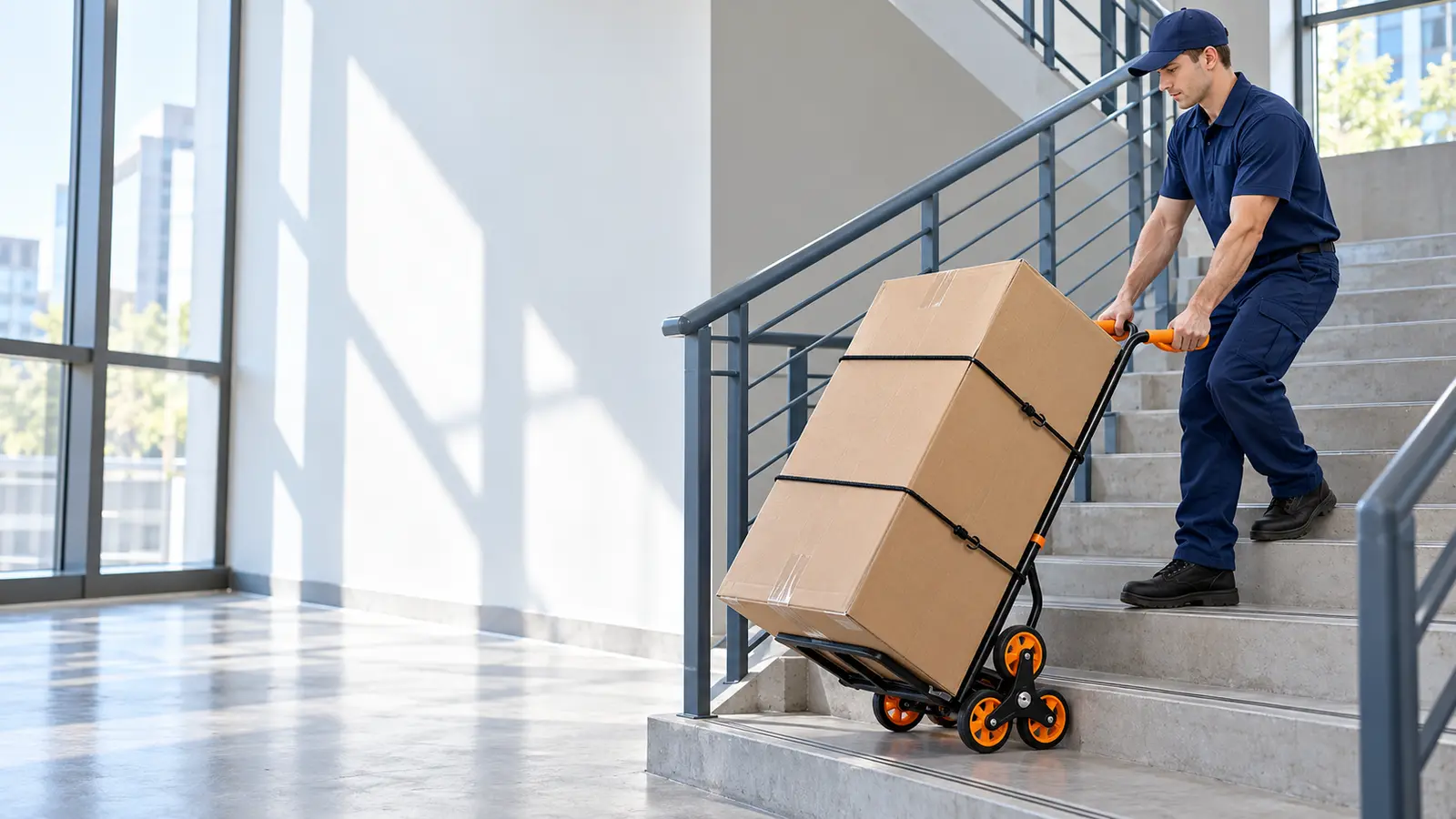
This manual cart may suit delivery, maintenance, office-move, stockroom and household tasks where suitable boxed goods must cross level floors and straight stairways. The supplied JL-LLC-C manual states a 440 lb (200 kg) maximum on flat ground and 330 lb (150 kg) on stairs. Because one advertiser graphic reverses those figures, buyers should confirm the exact model and both ratings in writing before use.
Verified specifications at a glance
| Product type | Manual folding stair-climbing hand truck |
|---|---|
| Configuration reviewed | JL-LLC-C in the supplied manual; confirm the seller’s exact model |
| Maximum stated load—flat ground | 440 lb / 200 kg for JL-LLC-C |
| Maximum stated load—stairs | 330 lb / 150 kg for JL-LLC-C |
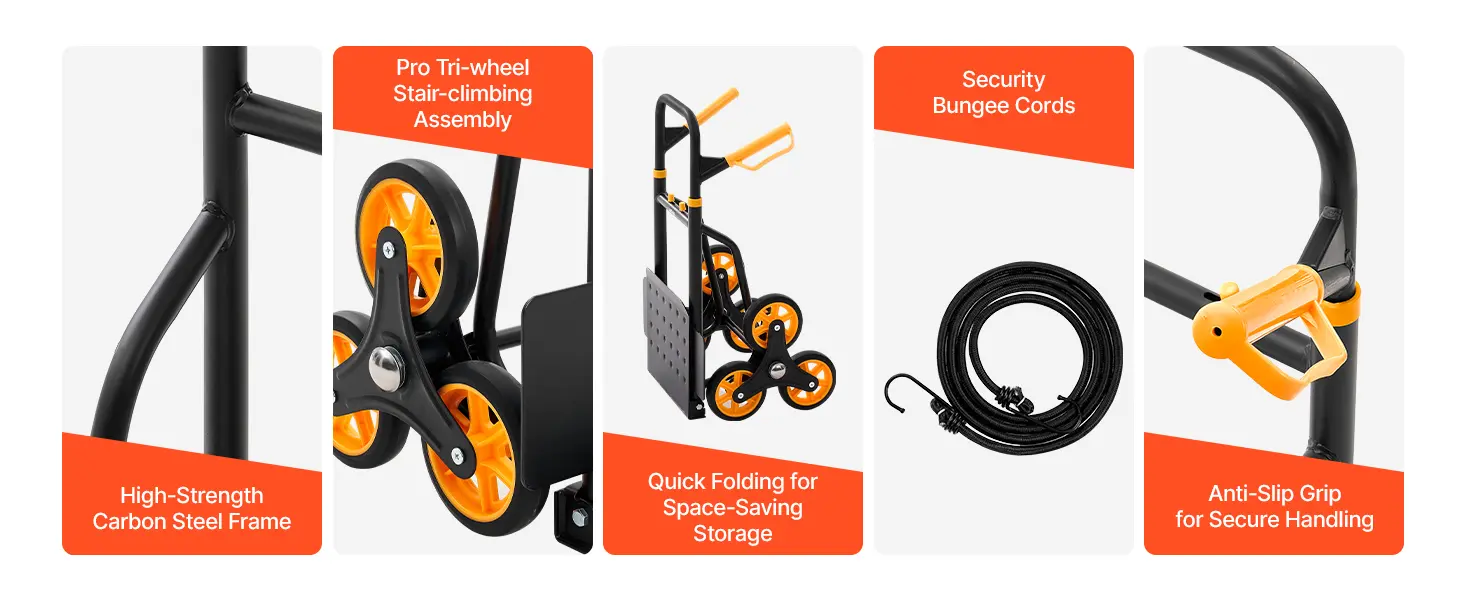
| Frame/material statement | Steel + PP in the manual; advertiser media describes a high-strength carbon-steel frame and TPR/PP wheel material |
| Climbing system | Two rotating tri-wheel sets; six climbing wheels in total |
| Storage | Folding loading platform and extendable locking handle |
| Included items listed | Cart frame, two wheel sets, two washers, two locking fasteners, two elastic binding ropes and user manual |
| Power source | None; manual operation |
| People carrying | Prohibited by the supplied manual |
| Product location | Not confirmed in the supplied material |
| Delivery and shipping | Not confirmed; check the current listing for the buyer’s destination |
How the tri-wheel stair mechanism works
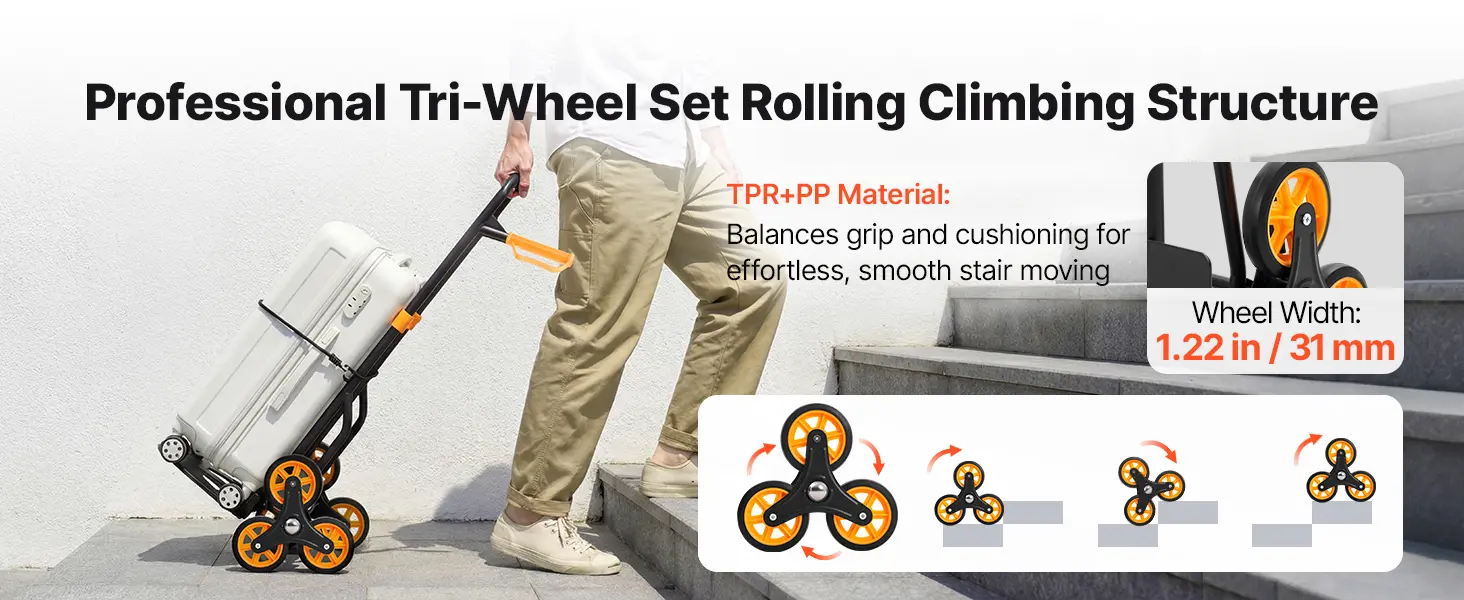
Instead of relying on one wheel at each side, the cart has three wheels arranged around a rotating hub. As the operator approaches a step, the cluster turns and places the next wheel on the following tread. The process repeats as the cart moves up or down the flight. On level ground, the lower wheels support normal rolling.
This is a manual system. It has no motor, powered track or automatic braking mechanism. The operator must still control the cart’s angle, speed and balance, keep the load close to the frame and manage the forces created by the staircase. The rotating wheel set can reduce the need to lift a conventional two-wheel hand truck over every stair edge, but it does not remove manual-handling risk.
Capacity: the important flat-ground and stair distinction
The supplied instruction manual covers two related configurations. For the JL-LLC-C, it states a maximum of 440 lb (200 kg) on flat ground and 330 lb (150 kg) when climbing stairs. The related JL-LLC is listed at 770 lb (350 kg) on flat ground and 440 lb (200 kg) on stairs. These are separate configurations and should not be combined.
One supplied promotional image incorrectly labels 330 lb as the flat-ground capacity and 440 lb as the stair capacity. That image has deliberately not been reproduced in this review. The instruction manual and matching marketplace specification identify the logical order—higher capacity on level ground and lower capacity on stairs—but the buyer should still confirm the model number and rating printed on the delivered product.
A maximum rating is not a recommended everyday load or proof that a task is suitable for one person. Load shape, centre of gravity, stair geometry, operator strength, handrail position and turning space can make a much lighter object difficult to control.
Folding frame, handle and securing cords
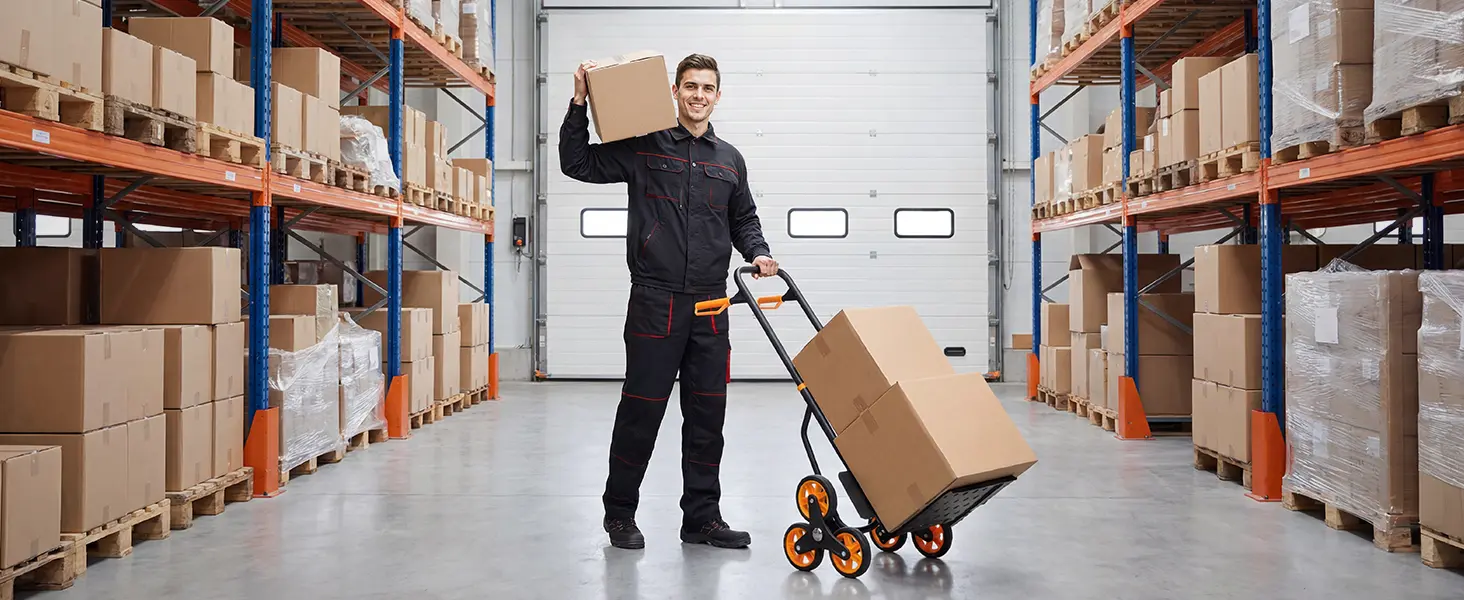
The advertiser media shows a black tubular frame, a perforated loading plate, orange hand grips and two elastic cords. The manual instructs the user to fold the loading platform down, press the locking buttons and pull the handle out fully until it locks. Before use, both the platform and handle should be checked in their operating positions.
Folding can make the cart easier to store in a van, stockroom or utility area. The two cords can help restrain suitable loads against the frame, but their condition and tension should be inspected. Loads with sharp edges, unstable contents or shapes that cannot sit securely on the toe plate may require a different restraint method or handling device.
Practical applications
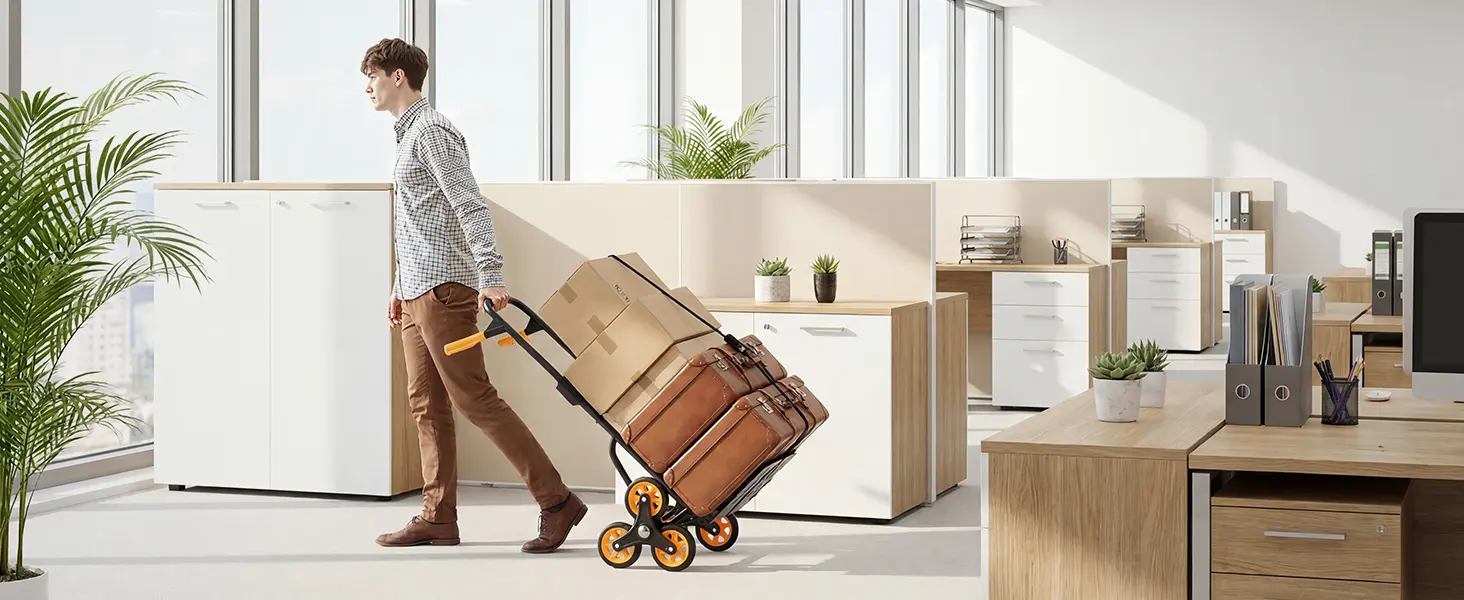
Likely applications include moving boxed supplies between floors, supporting office relocations, transferring maintenance materials, carrying compatible luggage, handling stock in small premises and moving suitable household items. Delivery teams may also value a manual cart where a lift is unavailable and the route has conventional stairs.
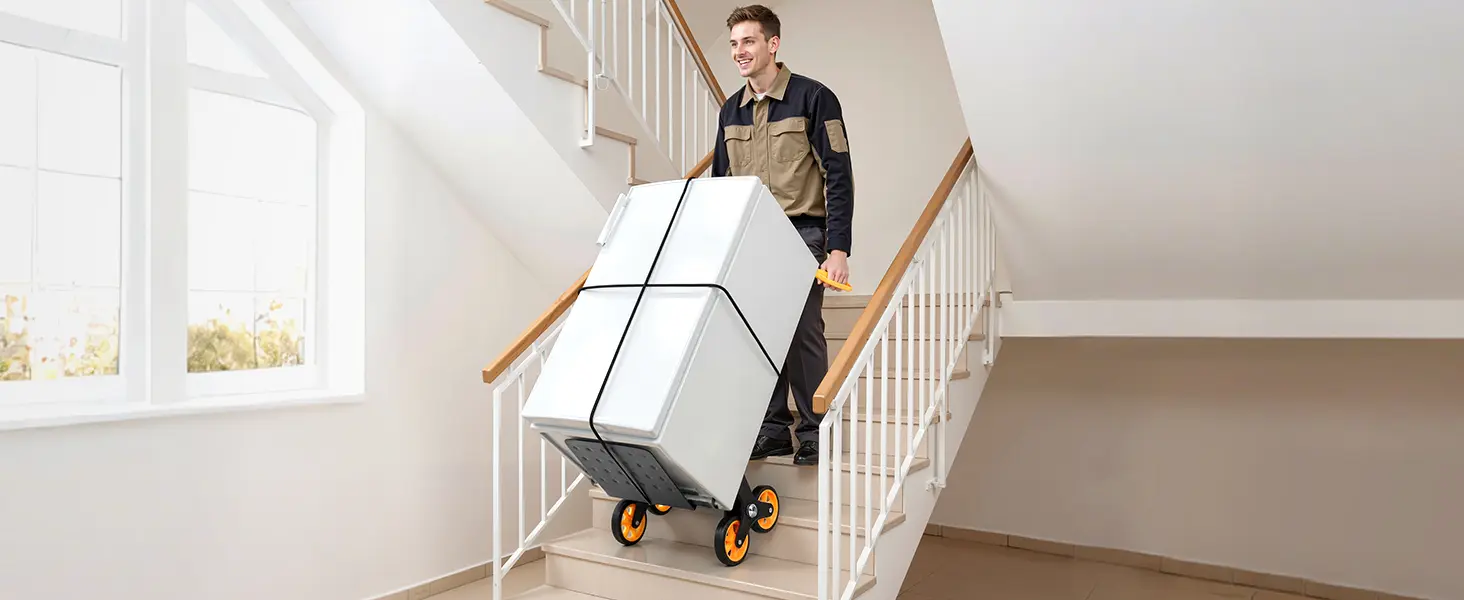
The platform and frame must physically support the item without unstable overhang. Appliances, tall cabinets and other bulky loads need additional consideration because their centre of gravity may sit high or block the operator’s view. The cart should never be used to carry a person, and the supplied manual expressly prohibits that use.
Stair use versus level-ground use
On a clear level floor, the cart functions much like a folding hand truck. The route should still be checked for thresholds, potholes, slopes, wet areas and pedestrian interaction. The manual specifically warns against moving too fast over potholes.
Stairs introduce additional forces and fewer recovery options. Before starting, check stair width, tread depth, riser height, gradient, surface condition, landings, turns, overhead clearance and escape routes. Confirm that the wheel cluster can seat properly on the treads and that the cart can be positioned at both ends of the flight without blocking others.
Manual-handling and safe-use considerations
- Confirm the exact product model and the applicable flat-ground and stair ratings.
- Keep the task comfortably within the stated capacity; never overload the cart.
- Inspect the frame, platform, handle locks, hubs, wheels, fasteners and cords before use.
- Centre the load on the plate and restrain it firmly against the frame.
- Do not allow the load to obscure the operator’s view of the route.
- Use appropriate footwear and task-specific PPE.
- Keep other people out of the movement path and control doors or landings.
- Use sufficient trained personnel where the load or route requires assistance.
- Move slowly and avoid sudden turns, impacts or uncontrolled descent.
- Follow the manufacturer’s instructions and the workplace manual-handling assessment.
For workplace use, include the cart in inspection and maintenance arrangements. A supervisor should define which loads and stairways are approved, when two-person handling is required and what conditions require the task to stop.
Product location, delivery and shipping
Product location: a verified physical inspection or dispatch location was not stated in the supplied material. Do not infer the product’s location from a seller address, telephone code, marketplace region or currency. Ask the seller where the exact unit will be dispatched from.
Delivery coverage: confirmed destination areas, shipping charges, dispatch time and delivery conditions were not available in the supplied materials. The marketplace may calculate options after a buyer selects a destination. Before payment, confirm availability to the delivery postcode, estimated dispatch and arrival dates, taxes or import charges, return address and the procedure for transit damage or missing parts.
Seller Offer and Availability — Checked 1 November 2026
Listings and seller terms can change. Use the dated section for current commercial details while the model-focused guidance on tri-wheel operation, manual handling and buyer checks remains useful after an individual offer changes or sells out.
Who should consider this cart?
The cart is most relevant to buyers who regularly move compatible loads across level floors and straight stairways and want a compact manual aid rather than a powered stair climber. Delivery crews, facilities teams, maintenance workers, stockroom operators, office movers and home users may find the format practical when the load and route have been assessed.
For very frequent stair work, unusually heavy or high-centre-of-gravity loads, curved staircases or tasks where the operator cannot safely control manual forces, buyers should assess whether a powered stair climber, lift, hoist or specialist moving service is more appropriate. That is a task-selection question, not a speculative fault in this cart.
What to confirm before ordering
- What exact model number will be supplied?
- Are 440 lb flat and 330 lb stair ratings printed on that unit?
- What are its unfolded and folded dimensions and net weight?
- What are the toe-plate dimensions and usable load area?
- Which wheel materials and dimensions apply to this configuration?
- Are two elastic securing cords included?
- How much assembly is required and which tools are supplied?
- Are replacement wheels, hubs, locks and cords available?
- What warranty and return conditions apply?
- Where is the product physically located and dispatched from?
- Can the seller deliver to the required postcode or country?
- What are the complete shipping charges, taxes and delivery time?
Frequently asked questions
Is the SucceBuy stair-climbing cart powered?
No. The reviewed configuration is a manual hand truck. Its rotating three-wheel clusters move from tread to tread while the operator controls and balances the load.
What load can it carry?
The supplied JL-LLC-C manual states 440 lb (200 kg) on flat ground and 330 lb (150 kg) when climbing stairs. Confirm that the seller is offering that exact configuration before relying on these ratings.
Does it fold for storage?
Yes. The supplied instructions describe a folding loading platform and a handle that locks in its extended position.
Are securing cords included?
The supplied manual lists two elastic binding ropes. Confirm package contents on the current seller page before ordering.
Can one person use it on stairs?
That depends on the load, route, operator capability and workplace procedure. A cart rating does not establish that a particular task is suitable for one-person handling.
Can it carry people?
No. The supplied manual expressly prohibits carrying people.
Where is the product located?
A physical inspection or dispatch location was not confirmed in the supplied material. Ask the seller to state it in writing.
Where can it be delivered?
Delivery areas, charges and lead times were not confirmed in the supplied material. Check the live listing and request a destination-specific quotation.
Final assessment
The SucceBuy stair-climbing cart combines a straightforward manual design with a folding frame, two tri-wheel clusters and supplied load-restraint cords. Its practical appeal is the ability to handle suitable items on both level ground and conventional stairs without adding a battery, charger or powered mechanism.
The most important buying step is model verification. For the reviewed JL-LLC-C configuration, the supplied manual states 440 lb on flat ground and 330 lb on stairs. Buyers should match those figures to the delivered unit, confirm the product’s dimensions and package contents, and assess the real load and route before work begins.
Join the discussion
Would you use a manual tri-wheel cart for deliveries, office moves or maintenance work? Tell us what you need to move—and what your staircase is like—in the comment section below.
HSSE TIPS — Worksite Safety Hub
Every Task. Every Person. Home Safe.
Your experience matters
Share your thoughts on this page
Have a question, a useful experience or a suggestion? Add your input below.
Comments are public. Keep them respectful and relevant. Do not share contact details, confidential information or emergency reports.
Comments on this page
Loading comments…