Product Reviews · Concrete Equipment · Buying Guide
500 L Self-Loading Concrete Mixer Truck Review: Applications & Buying Guide
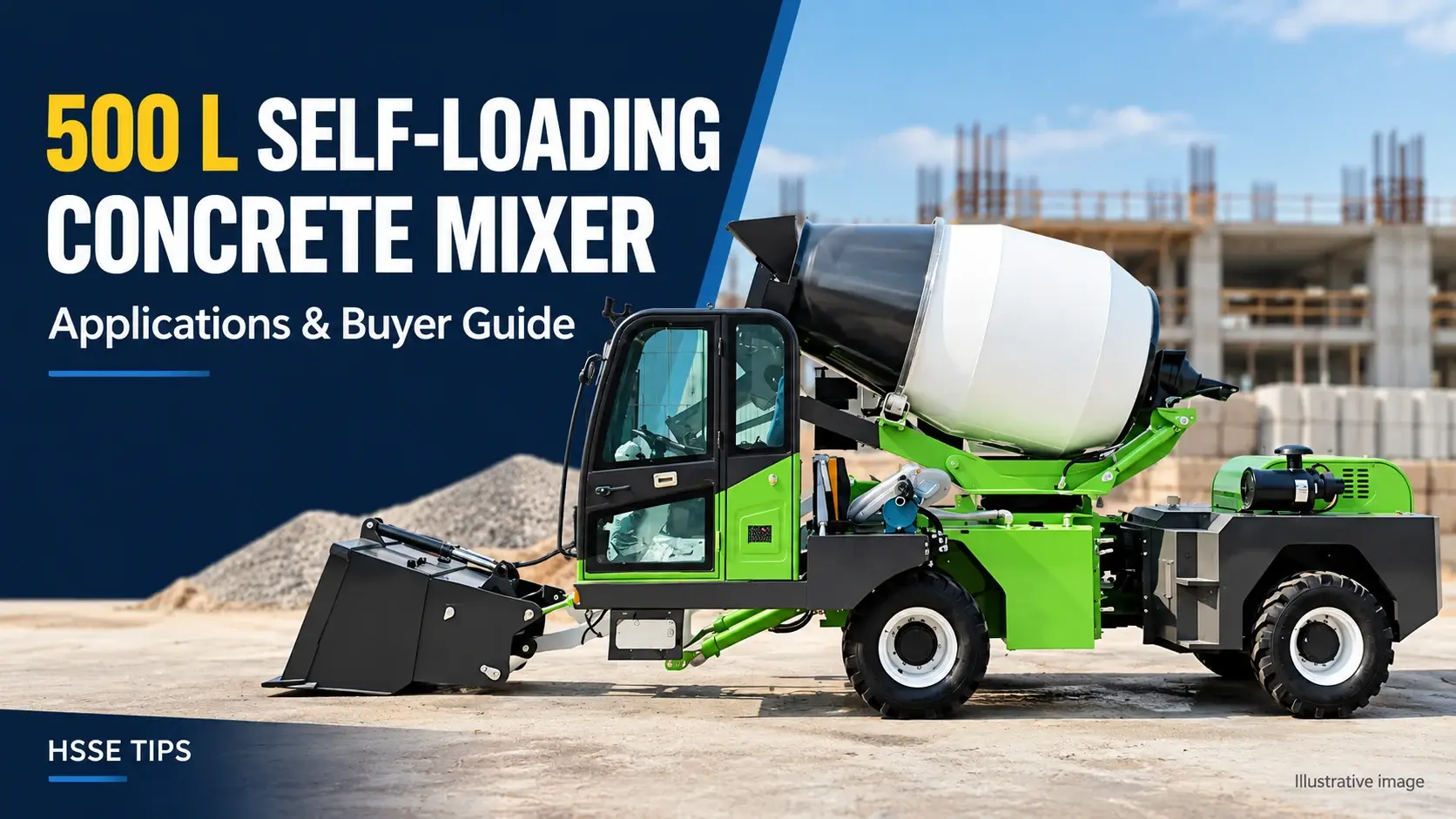
Load where your materials are. Mix where your crew needs concrete. A self-loading concrete mixer brings material handling and on-site mixing into one mobile machine—a useful concept for contractors managing repeated small pours, repair work and projects spread across a site.
This guide examines the 500 L self-loading concrete mixer truck offer linked below, using the supplied product images and demonstration video. It explains the machine concept, practical applications and the information buyers should obtain before requesting a quotation.
Affiliate disclosure: Worksite Safety Hub may earn a commission if you purchase through our affiliate link, at no additional cost to you.
Review basis: This is a media-based buying guide, not a hands-on test. The supplied materials display Yugong Machinery branding and several configurations. A unique model code and the exact specification of the linked 500 L variant have not been verified. Features shown across the range should be confirmed against the machine quoted to you.
View the 500 L mixer offer and request exact specifications →
What is a 500 L self-loading concrete mixer truck?
A self-loading mixer combines a loading bucket, mixing drum and wheeled chassis. The intended workflow is to collect suitable materials, charge the drum, mix and move the batch to the discharge point. Water supply and material measurement arrangements depend on the configuration.
The appeal is straightforward: the crew can plan concrete production around the work area. For a contractor moving between modest pours, that can make a mobile mixer worth evaluating alongside a stationary mixer or delivered ready-mix.
Understand the capacity label: 500 litres equals 0.5 cubic metres by volume. However, “500 L” must not automatically be read as 0.5 m³ of finished concrete per batch. Ask whether it describes total drum volume, loading capacity or rated mixed-concrete output. The confirmed discharge capacity is the figure to use for planning.
Where the self-loading mixer concept can fit
The supplier graphics illustrate building sites, road construction, pavement repair, factory projects and other civil works. Those are application categories; they do not establish the output or suitability of this specific variant for every job.
| Potential application | Why evaluate a mobile self-loading mixer? | What to confirm |
|---|---|---|
| Paths, yards and small slabs | Produce successive batches near the placement area. | Rated batch output, discharge access and required concrete specification. |
| Pavement and maintenance repairs | Move between separate repair locations within a controlled site. | Travel route, turning space and full cycle time. |
| Rural and dispersed construction | Bring the mixing process closer to work areas with suitable material storage. | Water availability, access width, ground conditions and service support. |
| Factory and site improvement projects | Coordinate smaller pours around an active worksite. | Traffic segregation, ventilation arrangements and discharge height. |
For structural concrete, follow the project engineer’s approved mix, batching and quality-control requirements. The machine’s capacity alone does not establish the concrete’s strength or consistency.
Features shown in the supplied product materials
Front loading bucket
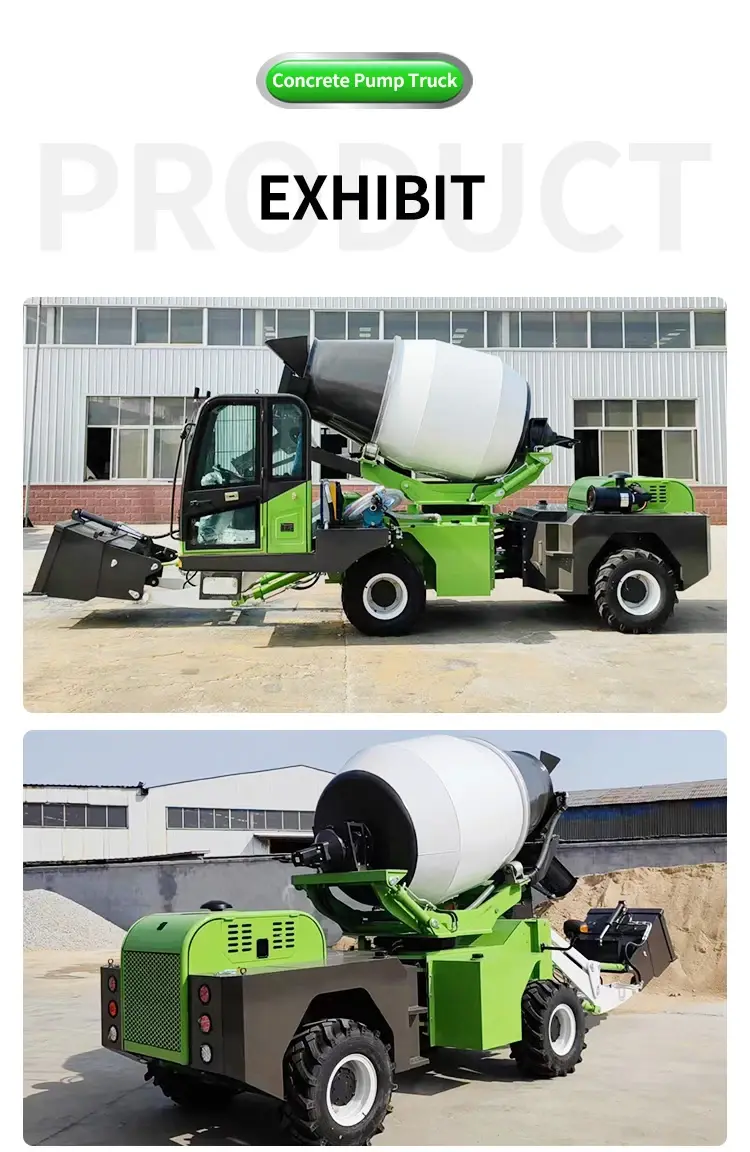
The images show a bucket and lifting arrangement ahead of the cab. This is central to the self-loading concept: materials can be lifted toward the mixer using the machine’s loading mechanism. Ask how cement is introduced, how aggregates are measured and which loading functions are included in the quoted build.
Mobile chassis and operator cab
The supplied photos show wheeled machines with treaded tyres and an enclosed operator cab. Evaluate the actual machine width, wheelbase, turning radius and loaded operating weight against your access routes. Tyre appearance is not a substitute for the manufacturer’s terrain and gradient limits.
Drum drive and positioning
The supplier graphics highlight the drum’s rotary motor and slewing support. The demonstration video also presents a rotating machine configuration. Ask for the exact drum-positioning range, discharge arrangement and operating procedure for the variant being offered.
Options to put into the written quotation
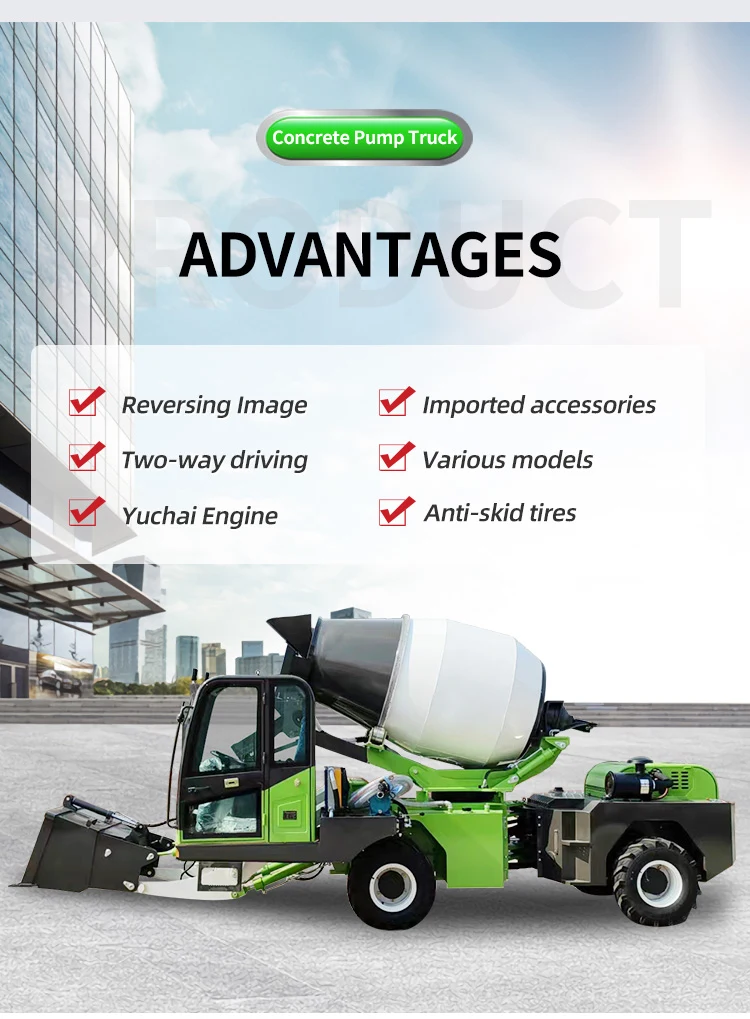
Range-wide promotional graphics mention a reversing image system, two-way driving, a Yuchai engine and customization. These are supplier-promoted features, rather than a verified equipment list for every 500 L machine. Have the seller state the engine make and model, visibility aids, steering/driving controls and selected options in writing.
Watch the supplied demonstration
The approximately 44-second supplied video shows a red self-loading mixer configuration, while the product photos include green and white machines. It illustrates the machine family and must not be treated as verification of the linked 500 L variant’s size, equipment or performance.
Plan production around the complete cycle
Useful output depends on more than drum size. Include material loading, water dosing, mixing, travel, discharge and the return journey in your production estimate. Ask for a continuous demonstration that shows those stages under conditions relevant to your project.
Illustrative calculation: If a seller confirms 0.5 m³ of finished concrete per batch, a 5 m³ pour would require 10 batches before allowing for waste or project tolerances. If a complete cycle takes 15 minutes, that represents 2.5 hours of cycling. These are planning assumptions—not verified performance figures for this offer.
This approach helps you choose equipment around the job: how much concrete is needed, how far it must travel and how steadily the crew can place it.
Check the offer and ask for a project-specific quotation →
Seller offer snapshot — 22 October 2026
This dated section separates the linked offer from the longer-term equipment guide. The affiliate short link was checked and redirects to AliExpress, but the destination listing could not be accessed during this review. Current price, stock and listing-specific terms therefore remain unverified.
| Offer detail | Information available for this review |
|---|---|
| Product description | 500 L self-loading concrete mixer truck, as identified in the supplied product description. |
| Branding in supplied media | Yugong Machinery. This does not independently identify the AliExpress storefront or exact model. |
| Product location / dispatch warehouse | Not verified. The supplied company introduction names Zhengzhou, China as the company location; it does not establish where this product is held or dispatched. |
| Price and availability | Request the current quotation and availability for the chosen configuration. |
| Delivery areas | No destination-country list was found in the supplied materials. Delivery to the USA, Canada, Nigeria or any other destination is not confirmed. |
| Shipping and commercial terms | Freight charges, dispatch lead time, transit estimate, delivery point, import charges, insurance, unloading, warranty and return terms were not verified. |
Buying from another region? Send the seller your country, city, postcode and preferred port or delivery address. Request a written quotation specifying the agreed Incoterm and named place, who handles customs clearance, applicable taxes and duties, and whether onward delivery and unloading are included. Ask for packing dimensions and shipping weight so your freight provider can assess the shipment.
The supplier graphic mentions “timely delivery,” but this is not a confirmed dispatch date, delivery guarantee or list of supported destinations.
Questions buyers ask before contacting the seller
What is the exact model?
A unique model code has not been verified from the supplied media. Request a model-specific datasheet and a photograph of the identification plate, then ensure the quotation uses the same model and configuration.
Does 500 L mean finished concrete output?
That needs seller confirmation. Request separate figures for geometric drum volume, loading capacity and rated discharge capacity. Use the discharge figure for batch planning.
Is a concrete pump included?
Some supplied graphics use the words “pump truck.” The photos do not establish an included concrete pumping system. Ask the seller whether the machine mixes and discharges through a chute or includes a separately specified pump. If pumping is included, obtain its model, rated output, aggregate limits and included pipeline equipment.
Does it weigh materials and dose water automatically?
The exact measurement system is unverified. Ask which scales, meters, controls and calibration instructions are included, and how the operator follows the required mix proportions.
Can it travel on public roads?
Public-road approval has not been verified. Ask for the documentation applicable to your destination and confirm local registration or transport requirements before planning road travel.
What should I ask about servicing and support?
Request the operator and maintenance manuals, service intervals, engine identification, spare-parts catalogue, consumables list and warranty terms. Confirm how parts and technical support reach your location and which items are included with delivery.
Can the seller customize the machine?
The supplied promotional material advertises customization. Ask which changes are available for this variant, their cost and lead time, and whether they affect dimensions, shipping or documentation.
How do I compare the total buying cost?
Compare written quotations on the same basis: machine specification, included equipment, freight, insurance, import charges, local delivery, unloading and commissioning. A destination-specific total is more useful than comparing headline machine prices alone.
A practical worksite plan
Use the manufacturer’s instructions and your site risk assessment to plan operation. Confirm operator training, pedestrian separation, loading and discharge exclusion zones, safe travel routes and the machine’s rated operating limits. Keep people clear of the bucket and moving drum mechanisms, and follow the prescribed isolation procedure before maintenance or clearing material.
Plan suitable protection for cement dust and wet-concrete contact, and provide a controlled washout area. For enclosed or partly enclosed work areas, assess exhaust exposure before selecting an engine-powered machine.
Is this mixer concept right for your project?
A 500 L self-loading concrete mixer is worth exploring when your work calls for mobile batching, repeated smaller pours and materials handled close to the job. The strongest next step is to match a confirmed machine specification to your concrete demand, access routes and delivery destination.
Send the seller your required output, project type, site access dimensions and destination. Ask for the exact model, rated batch discharge, included equipment and a complete delivered quotation. That turns an attractive machine concept into a purchase decision grounded in your project.
View the self-loading 500 L mixer offer and contact the seller →
Sources and editorial notes
Product evidence: nine user-supplied promotional JPGs and the approximately 44-second MP4, reviewed on 22 October 2026. The product-family company panel identifies Henan Yugong Machinery Co., Ltd.; the exact AliExpress seller identity, model and dispatch location remain unverified. The featured image is an AI-generated editorial illustration based on the supplied machine photographs.
General worksite references: HSE cement exposure guidance, HSE construction traffic management and OSHA concrete-work hazard controls. Apply the requirements relevant to your location and follow the machine manual.
Join the discussion
Which would matter most on your next concrete job: batch output, access width or delivery cost? Share your project type and your main question in the comments below.
Your experience matters
Share your thoughts on this page
Have a question, a useful experience or a suggestion? Add your input below.
Comments are public. Keep them respectful and relevant. Do not share contact details, confidential information or emergency reports.
Comments on this page
Loading comments…