Product Reviews · Specialist Patient Transport
Renault Master L2H2 165 CV Ambulance Review: Electric Bariatric Stretcher & Buying Guide
Affiliate Disclosure: Worksite Safety Hub may earn a commission if you make a qualifying purchase through links in this article. This does not change the price you pay.
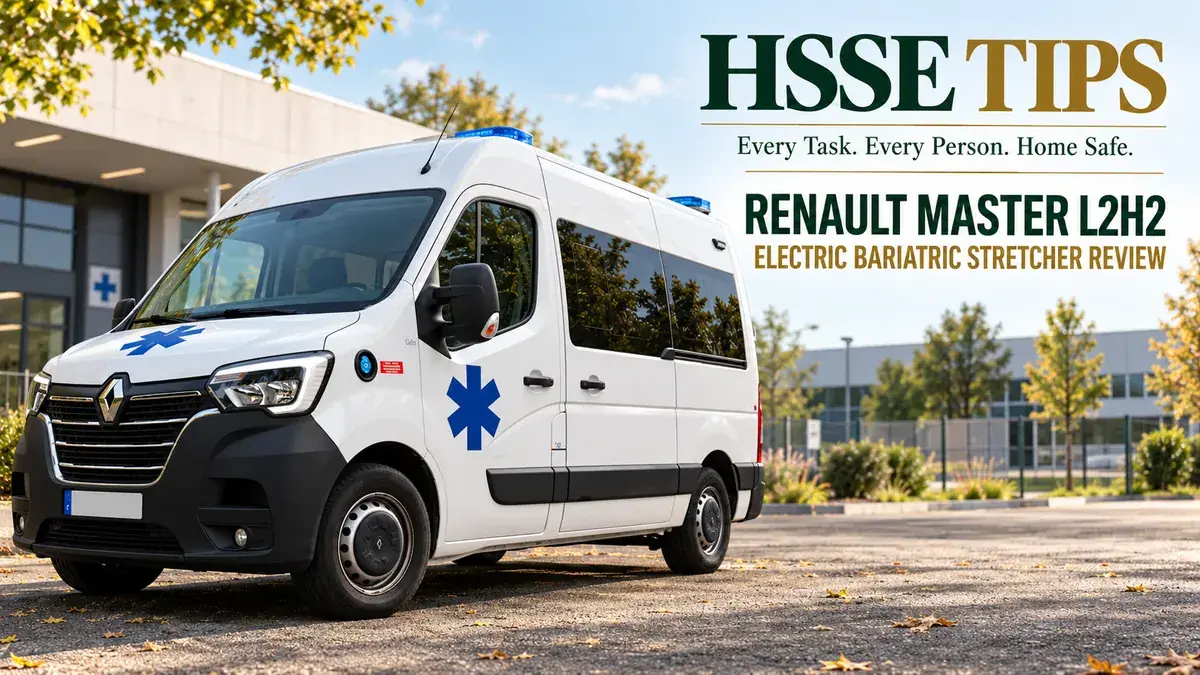
Specialist patient transport depends on a chain of compatible equipment: the stretcher, its restraints, the loading interface and the completed ambulance. Powered height adjustment can assist patient handling, but its usefulness depends on the equipment’s documented limits and the crew’s approved working procedures.
This Renault Master L2H2 offer has a clear distinguishing feature. The seller expressly includes an electric stretcher and bariatric extension kit, describing a 300 kg capacity. Original close-ups show PROMEBA branding and a PC-750 control panel, alongside a GIFA patient conversion.
This is an independently researched configuration review, not an operational test. It explains the evidence, separates powered lifting from loading, and identifies the documents needed to turn the advertisement into a defined procurement proposal.
EXPLORE THE RENAULT MASTER BARIATRIC AMBULANCE
Renault Master L2H2 165 CV Ambulance Overview
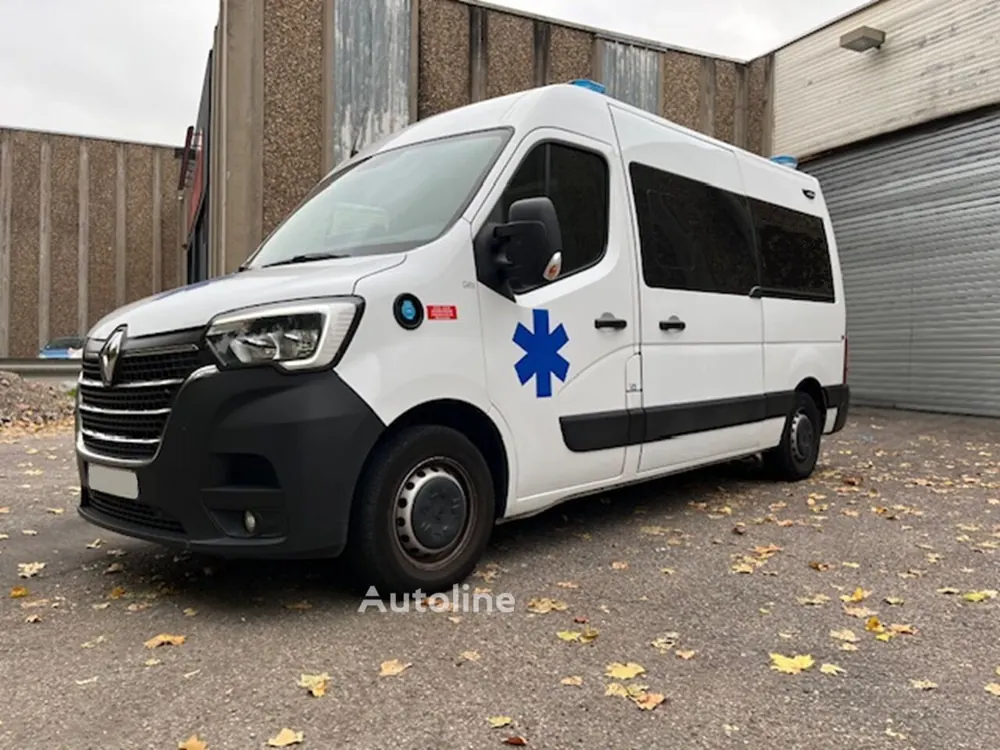
NORD EST AMBULANCES advertises this used white Master with 194,000 km, diesel power and GIFA bodywork. The listing identifies the body as L2H2 and displays 165 HP alongside 121 kW.
The dates require clarification: the manufacture field and description say May 2021, while the first-registration field says May 2017. Those entries do not establish a consistent chronology. Obtain the registration document and VIN build record before assigning a confirmed production or registration date.
The seller’s corresponding vehicle page repeats the 2021 description, gives 193,000 km, identifies front-wheel drive and describes Type B accommodation. The mileage difference should be resolved with a current vehicle-specific reading.
Understanding the Renault Master L2H2 Platform
The photographed body is consistent with the third-generation Master. Renault’s historical archive identifies Master III as the 2010–2024 generation. It should not be confused with the later fourth-generation Aerovan.
L2H2 denotes the length and roof-height combination within that generation: the L2 body length and H2 roof. These codes describe the base-vehicle format, not a measured patient compartment or a guaranteed carrying capacity.
The Renault chassis, GIFA conversion and PROMEBA handling equipment need separate identification. A common platform does not mean every Master ambulance has the same suspension, furniture, stretcher or approvals.
Engine, Transmission and Drivetrain
The marketplace specifies a turbocharged, four-cylinder diesel and 121 kW. In this listing, 165 CV describes metric horsepower, not taxable horsepower, engine displacement or payload. The displayed power figures are consistent at normal rounding.
The exact engine code, displacement, torque and emissions entry are not established for this vehicle. They should come from its identification and registration records, rather than another Master 165 variant.
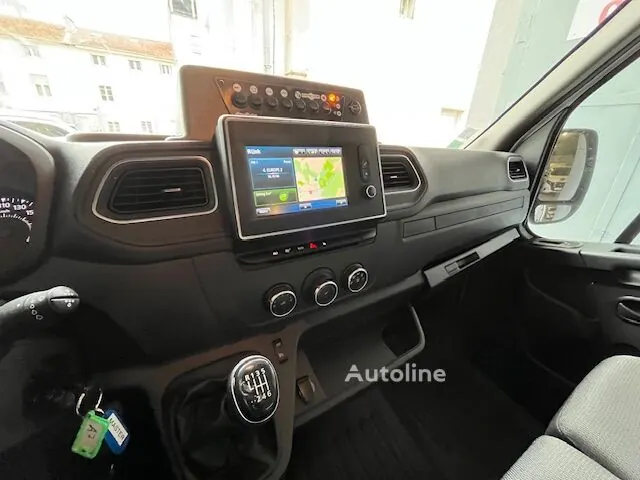
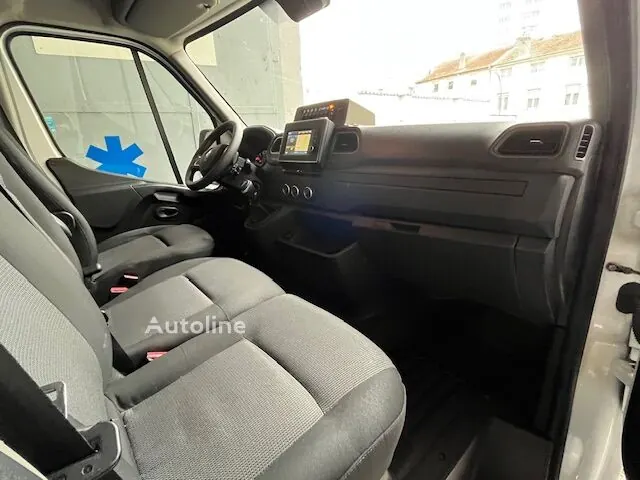
The gearbox field says automatic, but the advertiser’s cab photograph shows a conventional six-speed manual shift pattern. Treat transmission as unresolved until the seller matches the photographed cab and quotation to the selected VIN.
The seller’s matching vehicle page identifies front-wheel drive. That is a seller-specific statement, not an inference from L2H2. No four-wheel-drive claim is supported, and no fuel-consumption or operating-range result has been verified.
L2H2 Body Dimensions and Patient Transport Space
A 2021 Renault Trucks Master brochure provides generation-specific context: its front-wheel-drive L2H2 panel van uses a 3,682 mm wheelbase and lists 1,894 mm useful bare-van interior height.
These are reference-platform measurements, not independently measured dimensions of this ambulance. Conversion flooring, ceiling equipment, warning lights, steps and furniture affect the space and clearance that matter in service.
Request the completed vehicle’s length, width, height, loading height and patient-area drawing. For the bariatric kit, measure usable width around the extended stretcher and the passage through the rear doors. A bare-van loading width is not proof of usable clinical access after conversion.
Ambulance Conversion and Interior Design
The seller expressly names GIFA as the converter. Its matching product page describes Type B accommodation with three cab seats and two seats in the medical compartment. Those are seller statements to reconcile with the registration and conversion seating plan.
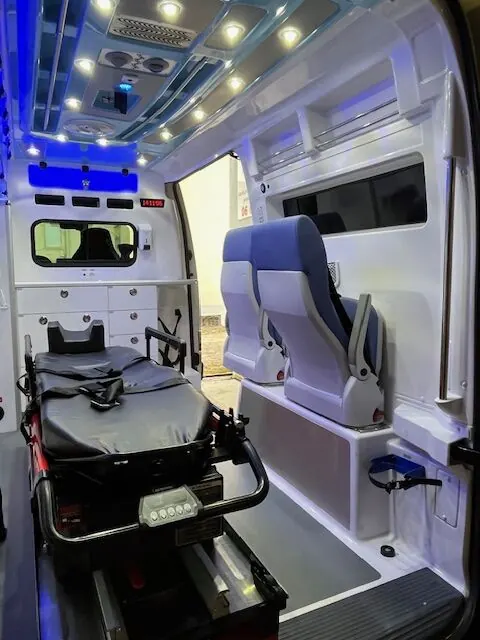
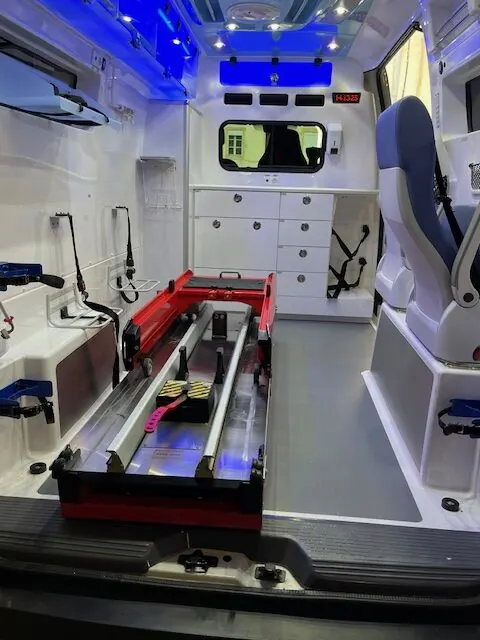
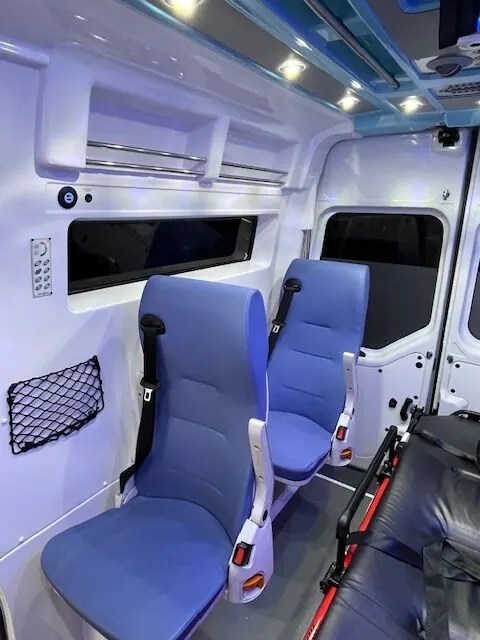
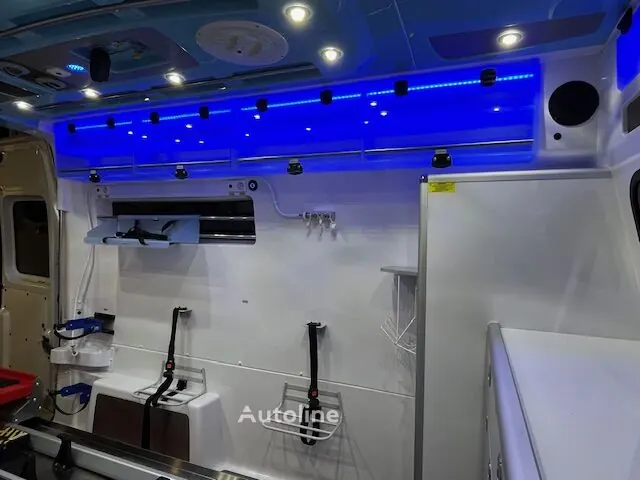
The photographs show a finished white interior, blue-and-white lighting, overhead storage, drawers, mounting positions, two attendant seats and a longitudinal stretcher rail. GIFA offers different Master interiors; the exact conversion model is not named here.
No particular interior polymer, antibacterial treatment or unit-specific ambulance certificate is established by appearance. Request the GIFA build plate, manuals, electrical drawings and applicable approval records.
Electric Bariatric Stretcher: The Key Feature
The inclusion wording is explicit: the ambulance is advertised with its electric stretcher and bariatric extension kit. This is stronger evidence than an accessory merely appearing in a photograph.
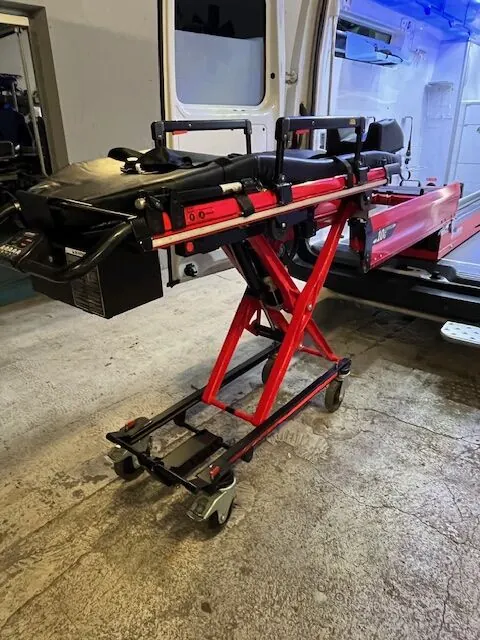
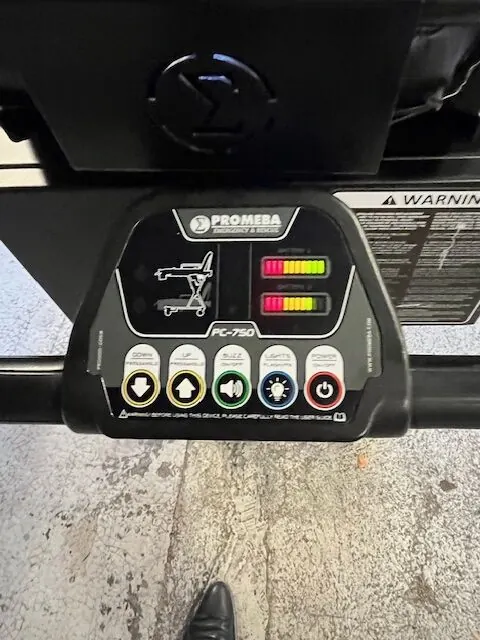
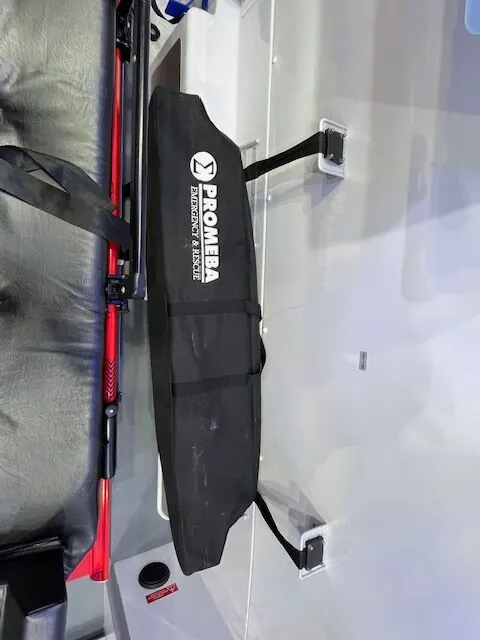
PROMEBA branding and the PC-750 designation are readable on the control panel. The gallery also shows the red lifting chassis, black patient surface, side rails, restraints and a PROMEBA-marked extension accessory.
The seller describes powered raising and lowering and quotes 300 kg. However, maximum patient weight, safe working load, accessory allowance and the complete installed system’s limit must be distinguished. The advertisement does not provide a readable rating plate defining those terms.
PROMEBA documentation has changed across versions. Do not apply a newer model’s higher rating to this used installation. Obtain the stretcher serial number, support-rail identity, extension-kit reference and matching manuals, and keep the advertised 300 kg figure as a seller claim until that assessment is complete.
DISCOVER THE ELECTRIC BARIATRIC STRETCHER
Powered Patient Loading and Handling
Three functions should be checked separately: raising the stretcher, bringing it into the ambulance and locking it for travel. A powered lifting chassis does not by itself establish a fully automatic loading system.
The seller describes an electric support and stretcher with up-and-down movement. A separate rail and retention installation is clearly photographed, but its exact model and the powered contribution during vehicle loading are not itemized.
PROMEBA’s PC-750 information and user documentation describe electro-hydraulic height adjustment, battery arrangements, compatible support systems and emergency lowering. They are model-family references, not a commissioning record for this vehicle.
Ask for a demonstration of the supplied combination, including charging, retention and backup operation. Battery chemistry, capacity, condition and charger inclusion are not specified. Manufacturer instructions cover external charging and charging through compatible installed equipment; the seller should identify what is actually supplied and functioning.
Patient Compartment and Accessibility
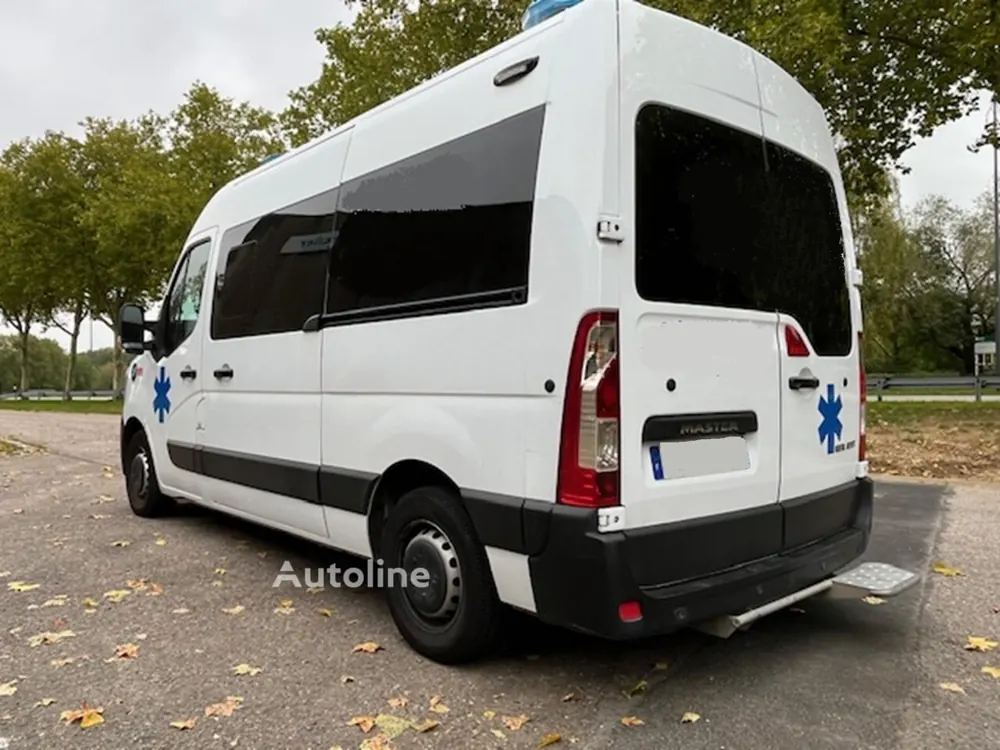
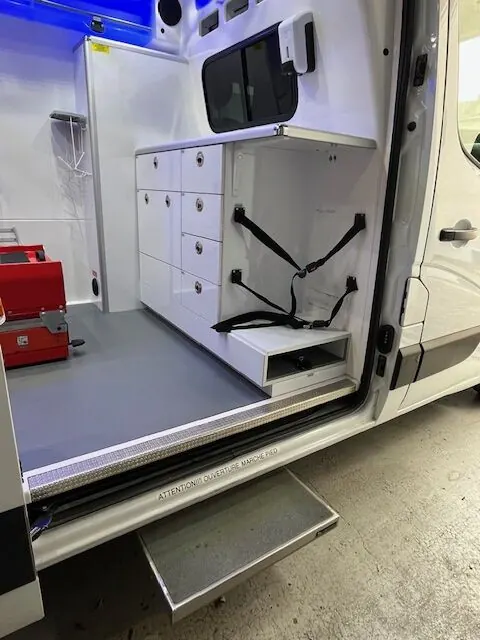
Rear double doors provide access to the stretcher installation. The side entrance has a step that the seller identifies as electrically operated, while a separate rear step is also advertised.
Two blue attendant seats sit beside the patient position, with visible belts and armrests. Their approved travel positions and access to the patient should be evaluated with the bariatric extensions fitted.
Additional width can affect reach, movement and door clearance. Request a dimensioned layout rather than assuming that the standard stretcher arrangement leaves the same working space with the extension kit installed.
Medical Equipment and Storage
The gallery shows overhead compartments, a multi-drawer unit, work surfaces, equipment mounts and cylindrical retaining brackets. These are useful integration features, but they do not identify every device accompanying the sale.
The stretcher and bariatric kit are expressly included. An oxygen supply package, filled cylinders, suction equipment, defibrillator, monitor, ventilator and emergency bags are not expressly itemized as included.
Keep fixed conversion systems, expressly included removable items, photographed items awaiting confirmation and optional additions separate in the inventory. Each supplied medical device should have a manufacturer, model and appropriate service documentation.
Emergency Warning and Communication Systems
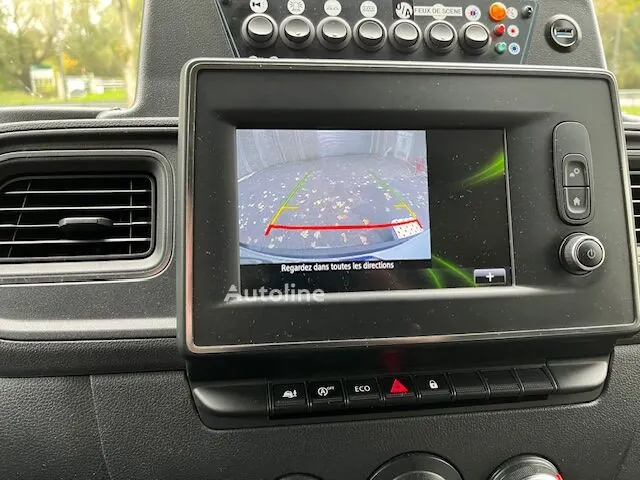
The seller lists front and rear LED warning units. Blue roof equipment appears in the exterior views, and the cab has an additional specialist control panel above the multimedia display.
Siren specification, radio equipment, network compatibility and scene-light output are not established. Existing switches or warning housings should be identified and demonstrated, without assuming a particular system from another GIFA vehicle.
Driver Cabin and Medical Crew Accommodation
The cab is photographed with left-hand drive, a driver seat and a two-place passenger bench. This supports the seller’s three-front-seat description, subject to the approved seating record.
GPS, reversing camera and rear parking sensors are expressly listed. The original display photographs show navigation and a reversing-camera view. No unlisted driver-assistance package is assigned to the vehicle.
Five seats overall, as described on the seller’s matching page, is not a five-patient capacity. Patient positions, attendant seats and cab occupants serve different purposes in the completed layout.
Heating, Ventilation and Climate Control
The seller describes front and rear air conditioning, patient-compartment climate control and independent WEBASTO heating. Ceiling outlets and lighting are visible in the medical area.
No cooling output, heating capacity, ventilation rate or parked operating duration is given. Specify the intended use and request a demonstration covering the patient area as well as the cab.
Auxiliary battery capacity, inverter rating and external electrical-supply arrangements are not published. A powered stretcher charging provision must be checked as part of the conversion’s actual electrical installation.
Dimensions, Payload and Capacity
No verified completed gross weight, unladen weight, axle-weight schedule or remaining payload is supplied in the reviewed offer. These are central to the assessment of any specialist patient-handling installation.
The stretcher rating and vehicle payload are different limits. The completed vehicle must accommodate the patient, stretcher and support, extensions, crew, fuel, devices and consumables within its plated gross and axle limits.
Have the selected ambulance weighed with the agreed equipment. Do not derive an approved patient mass from the 300 kg advertisement alone, and do not substitute a generic L2H2 van’s payload for the converted vehicle’s available capacity.
Specialized Healthcare and Patient Transport Applications
The expressly included powered stretcher and extension kit make this a relevant offer for specialist patient transport companies, hospitals and ambulance fleets evaluating bariatric transfer provision.
Potential use should be assessed through the complete handling route: collection environment, transfer equipment, door clearance, loading interface, restraints and vehicle weights. Bariatric extensions are part of that assessment, not an independent clinical service classification.
The seller describes a Type B ambulance, but the advertisement does not establish a supplied intensive-care or advanced-life-support device package. Match the documented vehicle and final equipment to the intended service.
The MAN TGE 3.180 review illustrates a different inclusion situation, where the stretcher is photographed without a published sale inventory. The Sprinter 315 review covers another expressly described conversion package. Their equipment and ratings should not be transferred to this Renault.
Safety and Operational Considerations
Acceptance should cover the vehicle, GIFA conversion and patient-handling equipment together. Review maintenance records, brakes, tyres, suspension, electrical protection, stretcher locking, restraints and attachment compatibility.
Arrange manufacturer-appropriate operator training and an assessment of the actual loading environment. Powered equipment can assist handling, but does not remove the need for the staffing, assistance and procedures required for the task.
Request cleaning guidance, device certificates and any medical-gas inspection records for supplied systems. Confirm the applicable ambulance approval and equipment standards for the destination. These are routine procurement requirements, not findings of an inspected fault.
Technical Specifications
Renault Master L2H2 165 CV Base Vehicle Specifications
| Specification | Evidence and scope |
|---|---|
| Advertised model / body | Renault Master L2H2 165 CV / L2 length and H2 roof, seller-listed |
| Condition / mileage | Used / 194,000 km marketplace; 193,000 km matching seller page |
| Date entries | 2021-05 manufacture / 2017-05 first registration: conflicting seller entries |
| Engine / power | Turbocharged four-cylinder diesel / 121 kW, displayed alongside 165 HP |
| Transmission evidence | Automatic listing field / six-speed manual pattern in cab photo: unresolved |
| Drive / seating | Front-wheel drive; three cab + two medical-area seats, matching seller page |
| Suspension | Seller-described softened suspension; exact system unspecified |
Ambulance Conversion and Medical Equipment Specifications
| Specification | Evidence and scope |
|---|---|
| Converter / seller classification | GIFA / Type B on matching seller vehicle page; unit documents required |
| Patient handling inclusion | Electric stretcher and bariatric extension kit expressly included |
| Access | Rear doors; electric side step and rear step seller-listed |
| Interior | Two attendant seats, drawers, overhead storage and equipment mounts pictured |
| Climate | Front/rear A/C, medical-area climate and independent WEBASTO heating seller-listed |
| Warning / driver aids | Front/rear LED warning units, reversing camera/sensors and GPS seller-listed |
| Additional clinical devices | No express oxygen, suction, monitor, defibrillator or ventilator inventory |
Electric Bariatric Stretcher Specifications
| Specification | Evidence and scope |
|---|---|
| Manufacturer / model marking | PROMEBA / PC-750 readable on pictured control panel |
| Included items | Electric stretcher and bariatric extension kit, seller-stated |
| Advertised capacity | 300 kg seller claim; plate-defined patient/system limit not verified |
| Powered function | Raising and lowering described; electric lifting chassis pictured |
| Support / vehicle loading | Separate rail pictured; exact rail model and fully automatic loading unconfirmed |
| Battery / charger | Type, capacity, condition and supplied charger not itemized |
| Backup / certification | Manufacturer family documentation covers emergency lowering; serial-matched manuals and installed-system certificates required |
VIEW CURRENT PRICE & AVAILABILITY
Current Seller Offer — Verified 25 October 2026
Product Location: Jarville-la-Malgrange, France. This is the vehicle location stated in the marketplace listing.
| Specification | Evidence and scope |
|---|---|
| Seller / reference | NORD EST AMBULANCES / Autoline LL43675 |
| Price / currency | Price on request; amount and quotation currency not published |
| Dates / mileage | 2021-05 manufacture and 2017-05 registration entries conflict; 194,000 km marketplace vs 193,000 km seller page |
| Condition / engine | Used / turbocharged four-cylinder diesel, 121 kW advertised |
| Transmission / drive | Automatic entry conflicts with manual pattern pictured / seller page says front-wheel drive |
| Conversion / included handling equipment | GIFA; electric stretcher and bariatric kit expressly included, advertised 300 kg |
| Other medical equipment | No complete itemized medical-device package published |
| Availability / shipping | Advertisement accessible; stock, destinations and transport/export terms to confirm |
Price is available on request; no amount or currency quotation is published. Confirm current availability and the full payable total, including tax treatment and the exact stretcher, kit, batteries and charger supplied.
The marketplace gives 194,000 km, while the seller’s corresponding page gives 193,000 km. May 2021 manufacture conflicts with the May 2017 registration entry, and the automatic gearbox field conflicts with the photographed manual pattern. Request a corrected, VIN-specific specification.
The seller mentions mechanical and bodywork preparation, with painting in the marketplace description. Obtain the scope and records of that work rather than treating it as an independent condition assessment or a warranty.
The company website uses general quick-delivery wording; no lead time, named destination or transport contract is specified for this ambulance.
Delivery destinations, shipping arrangements, and applicable transport terms were not specified in the information reviewed. Prospective buyers should confirm these details directly with the seller.
Collection, export documents, transport charges, lead time, payment and any warranty need a written agreement. General marketplace delivery features do not establish a seller shipping commitment.
What Buyers Should Confirm Before Purchasing
First reconcile the vehicle identity: VIN, year, first registration, current mileage, engine code and gearbox. Obtain completed dimensions, plated weights and a weighing record.
Then request the PC-750 serial plate, support-rail model, bariatric-kit reference and rating definitions. Confirm whether limits apply to the patient alone or include accessories, and establish the permitted configuration, compatible restraints and documented vehicle-floor installation.
The handover should include the matching manuals, equipment service information, batteries, charging equipment and a demonstration of lifting, loading, locking and backup operation. Complete the medical-device inventory and destination registration arrangements before deployment.
Manufacturer Demonstrations and Advertiser Media
The advertisement contains 27 photographs and no vehicle-specific seller video was identified. The following PROMEBA videos are linked by the manufacturer for the PC-750 family. They explain controls and batteries, and loading and unloading; they are not footage of this particular ambulance or proof of its supplied specification.
Frequently Asked Questions
1. What does L2H2 165 CV mean?
L2H2 identifies the Master’s length and roof combination. Here, 165 CV is the advertised metric horsepower rating, displayed alongside 121 kW; it is not a payload figure.
2. Which electric stretcher is pictured?
PROMEBA branding and PC-750 markings are visible on the control panel. Obtain the serial plate and matching manual to confirm the exact version.
3. Are the stretcher and bariatric kit included?
Yes, the seller expressly describes the ambulance as supplied with the electric stretcher and bariatric extension kit. Identify all components in the final order.
4. Can it carry a patient weighing 300 kg?
The seller quotes 300 kg, but the plate-defined patient limit, complete-system rating and vehicle payload have not been established together. Those must be verified before assigning an approved patient mass.
5. Does it have automatic powered loading?
Powered raising and lowering are described. A separate support rail is pictured, but a fully automatic loading system is not confirmed for this installation.
6. What battery and backup arrangements are supplied?
Battery type, capacity and charger inclusion are not itemized. PROMEBA documentation covers charging and emergency lowering, but the seller should demonstrate the exact supplied equipment.
7. Is it a 2021 automatic ambulance?
That is not fully established: the date fields conflict and the cab photograph shows a manual shift pattern despite the automatic listing entry. Request the corrected vehicle documents.
8. Where is it, what does it cost, and can it be shipped?
It is listed in Jarville-la-Malgrange, France, with price on request. Delivery destinations and export or transport terms were not specified in the reviewed offer.
Final Verdict
This Renault Master offer has a meaningful specialist feature: an expressly included electric stretcher and bariatric extension kit, supported by identifiable PROMEBA PC-750 controls and detailed original photographs. GIFA conversion, front and rear climate provision, access steps and attendant accommodation add useful procurement detail.
The next step is to connect those features to a corrected vehicle specification and a documented handling-system rating. For a specialist transport buyer, that defines the vehicle’s actual role more reliably than the stretcher capacity headline alone.
Join the Conversation
Which detail would you prioritize when procuring a specialist patient transport vehicle: equipment compatibility, loading access, charging provision or completed weights? Share your purchasing priorities below.
Your experience matters
Share your thoughts on this page
Have a question, a useful experience or a suggestion? Add your input below.
Comments are public. Keep them respectful and relevant. Do not share contact details, confidential information or emergency reports.
Comments on this page
Loading comments…