Classic Motorcycles · Italian Racing Heritage · 17 min read
1961 Parilla 350cc Bialbero Review: Italian Racing Heritage & Collector's Buying Guide
This article contains affiliate links. We may earn a commission from qualifying purchases made through these links, at no additional cost to you.
This review is based on publicly available historical references, product information and seller documentation. Worksite Safety Hub has not independently inspected, authenticated or road-tested the advertised motorcycle.
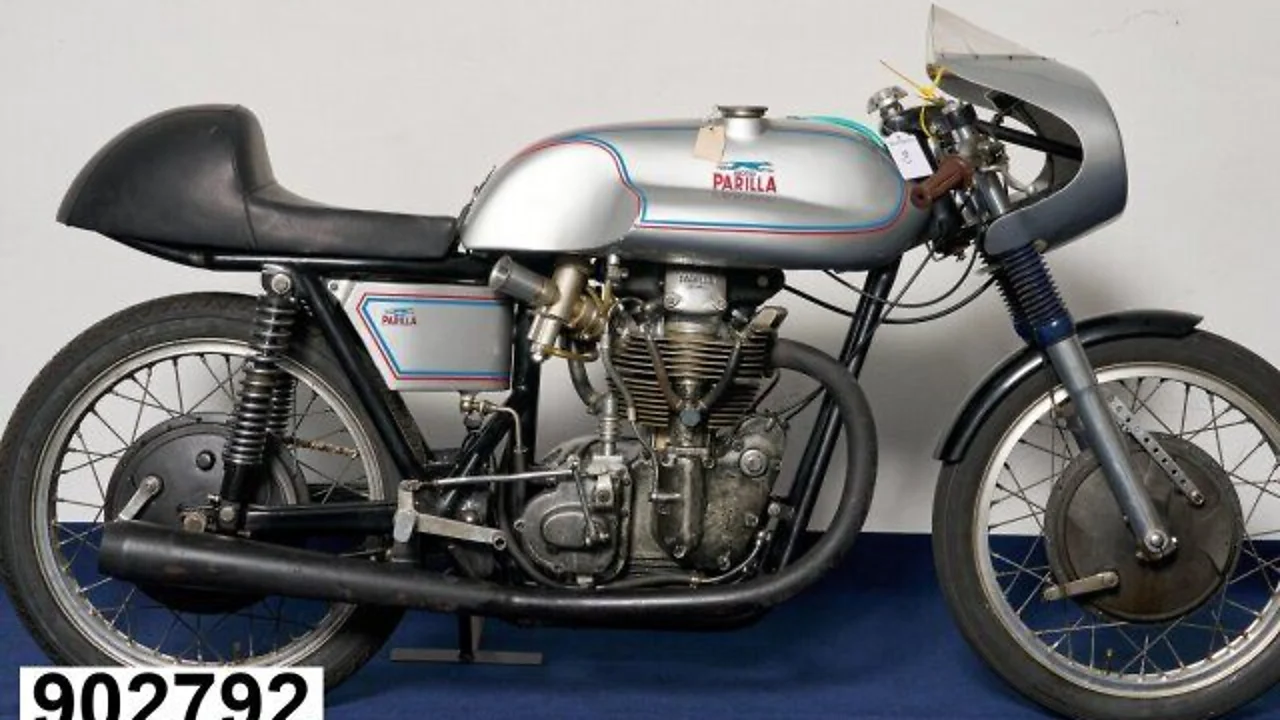
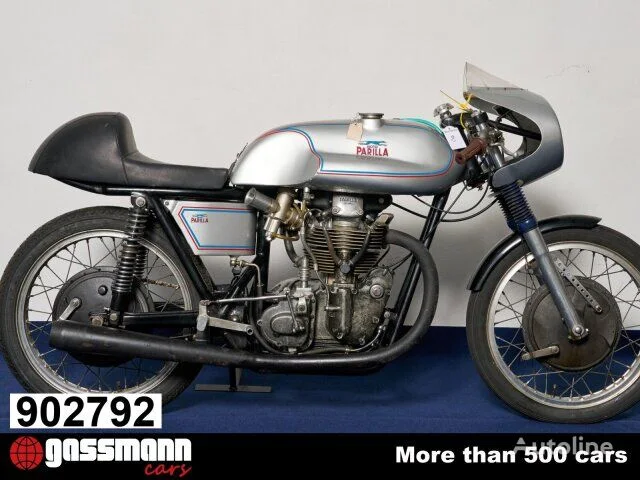
Some racing motorcycles tell their story before the engine even turns. The slim silver tank, exposed single-cylinder engine, clip-on controls and purposeful seat of this Parilla speak the language of post-war Italian competition: lightness, mechanical ingenuity and the belief that a small factory could challenge established names through clever engineering.
The live offer identifies this machine as a 1961 Parilla 350cc Bialbero racing motorcycle. It is presented in silver, described as an older restoration and offered from Bovenden, Germany, at €69,900. Those headline facts are easy to read; the harder—and more interesting—work for a collector is establishing how its frame, engine, cylinder head, restoration and claimed collection history fit together.
Check the live listing, then ask for the complete identity and provenance file.
Parilla 350cc Bialbero at a glance
| Manufacturer | Parilla; “Andere” is the marketplace’s classification, not the maker |
|---|---|
| Model | 350cc Bialbero Racing Motorcycle |
| Year / first registration | 1961 / 1 July 1961 |
| Engine | 350cc petrol single-cylinder; twin-cam racing configuration |
| Advertised output | 24 kW / 33 PS; description says 33 bhp |
| Displayed mileage | 1,001 km / 622 mi; meaning and accuracy require confirmation |
| Condition | Used; seller describes an older restoration and “roadworthy” status |
| Colour | Silver / metallic |
| Reported history | Discovered in the United States; formerly part of the Enrico Bernardi Museum collection |
| Included part | Spare cylinder head, subject to confirmation in the contract |
| Product location | Bovenden, Germany |
| Asking price | €69,900; VAT not separately shown |
| Seller / reference | Gassmann GmbH / 902792 |
| Availability | Listing active when verified; prior sale and errors reserved |
The story behind Parilla's racing heritage
Giovanni Parrilla—whose motorcycles used the shortened Parilla spelling—entered motorcycle manufacture in Milan during the energetic reconstruction years after the Second World War. The company’s first racer appeared in 1946, a 250cc overhead-camshaft single designed by engineer Giuseppe Salmaggi, already known for work connected with the Gilera Saturno.
That early machine mattered because it was not simply a copy of a British single. Its bevel-driven camshaft showed the influence of the Norton racing motorcycles Parrilla admired, yet it used its own unit-construction engine and transmission, geared primary drive and a purpose-built welded chassis. Parilla was demonstrating that a young Italian marque could combine familiar racing ideas with a compact, modern package.
Sources differ slightly on the date used for the Bialbero’s appearance: the seller narrative describes an improved twin-cam version in 1947, while later histories place the Bialbero’s release in 1948. The safest conclusion is that Parilla developed its twin-cam racer during the late 1940s. A 350cc version followed around 1950 and competed in Italy’s demanding long-distance road races as well as Grand Prix-level events.
This review does not assign every specification of an early 1950 racer to the advertised 1961 machine. Parilla competition motorcycles evolved, and individual historic racers can acquire replacement parts, later developments and restoration choices over decades.
What makes the Parilla 350cc Bialbero special?
“Bialbero” literally means twin camshaft. Two overhead camshafts allow the inlet and exhaust valves to be controlled separately at the top of the cylinder head. For a racing engineer, that arrangement can support precise valve timing and the breathing needed at high engine speeds. For a collector, it also represents a highly visible piece of period mechanical ambition.
Parilla wrapped that sophisticated top end around a single-cylinder format. A racing single can be wonderfully direct: one piston, one combustion chamber and an exhaust note that communicates every change of load. Yet simplicity in cylinder count does not make a twin-cam racing engine simple to restore. Correct gears, shafts, bearings, valve-train parts, lubrication clearances and ignition settings demand specialist knowledge.
The advertised motorcycle is especially intriguing because the seller says its engine uses a late Manx Norton-type cylinder head. That wording should not be converted into a claim of verified factory originality. A prospective buyer should ask whether “type” describes a Parilla development influenced by Norton, an adapted Norton component, or a later modification, and should compare casting marks, dimensions and period photographs with a marque expert.
Engine, performance and mechanical engineering
The current listing gives 350cc, one cylinder and approximately 33 hp. It does not publish bore and stroke, compression ratio, carburettor specification, ignition system, gearbox ratios, torque or verified maximum speed. Historical references for other Parilla 350 Bialbero racers are useful for understanding the model family, but they should not be treated as the build sheet for this motorcycle.
Likewise, the displayed 1,001 km is not automatically a lifetime mileage. Competition machines may not use road-type odometers consistently, and restoration work can change instruments. Ask what the figure represents, whether the instrument is period-correct and whether any records support it.
A pre-purchase mechanical examination should include a cold start only if the owner and specialist agree it is safe. Check oil pressure or flow, cam drive, valve train, compression, smoke, abnormal noise, fuel leaks, carburetion, ignition, clutch and gearbox. Inspect the engine and frame numbers without aggressive cleaning, and record casting marks and fasteners before comparing them with documentary evidence.
Design, frame and racing character
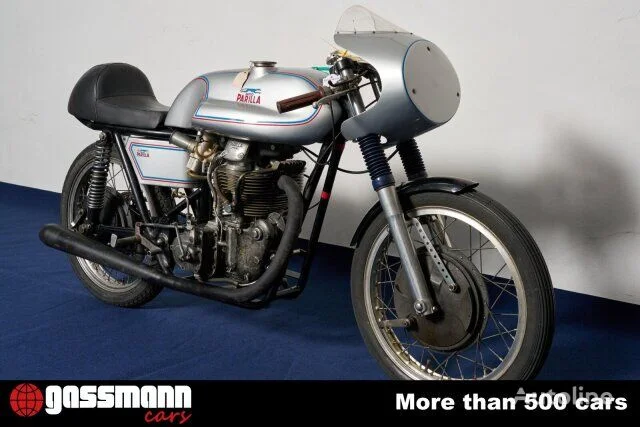
The motorcycle’s compact proportions are immediately persuasive. A long silver fuel tank guides the rider forward toward low bars and a small screen; the raised rear of the black racing seat braces the rider under acceleration. The engine sits exposed in a black tubular frame, with twin rear dampers and a telescopic fork. Large drum brakes and wire wheels suit the visual language of the period.
Those visible details are also inspection points. Examine the frame around the steering head, engine mounts, swingarm pivot and shock mounts for repairs, misalignment or corrosion. Check wheel rims, spokes, hubs, brake linings, fork stanchions, dampers, tyres and controls. Paint can make an older restoration attractive without proving the condition beneath it.
For display, the patina of an older restoration may be part of the appeal. For demonstration or competition, mechanical integrity and event eligibility matter more than appearance. Decide the intended use before planning work: museum conservation, static collection, occasional parade use and historic racing can require very different decisions.
A motorcycle with an interesting collection history
The seller says the motorcycle was discovered in the United States and was formerly part of the Enrico Bernardi Museum collection. A 2024 Bonhams auction catalogue carried the same account, listed engine number 012 and later noted frame number 1. It also recorded that the motorcycle was offered with no documents. These details make the provenance question more important, not less.
The auction catalogue also said the machine had been discovered by Giuseppe Rottighi and was “believed unique.” That is an attributed auction/seller statement, not proof that no comparable survivor exists. Establishing rarity calls for factory records, specialist registers, period photographs and comparison with known machines.
Ask for the complete chain from the United States discovery through the reported museum association, the 2024 auction and the current seller. Useful evidence could include old bills of sale, museum inventory numbers, dated photographs, correspondence, shipping records, restoration invoices and expert reports. The name of a museum adds interest, but documentation is what converts a story into defensible provenance.
Why collectors may be interested
- Italian racing engineering: the twin-cam single represents a technically ambitious chapter in Parilla’s post-war competition work.
- Visual presence: its silver tank, compact chassis and exposed mechanicals create the appeal of a purposeful period racer.
- Research potential: the unusual head description, reported collection history and numbered components invite serious archival study.
- Institutional relevance: it may suit a museum or collection focused on Italian design, racing singles or post-war industrial recovery—after authentication.
- Event interest: display at heritage gatherings may be possible, while any track use remains subject to mechanical preparation and eligibility rules.
None of those points guarantees future value. A collector should buy on the strength of the machine, evidence, condition and personal collecting goals—not on an assumption of investment appreciation.
Technical specifications
| Configuration | Historic racing motorcycle |
|---|---|
| Engine | Seller-listed 350cc petrol single cylinder |
| Valve gear | Bialbero / twin overhead camshafts; exact component identity requires authentication |
| Cylinder head | Seller describes a late Manx Norton-type head |
| Power | Seller-stated 24 kW / 33 PS, description states 33 bhp |
| Transmission | Not published; confirm type, ratios and originality |
| Frame / engine numbers | A 2024 Bonhams record noted frame no. 1 and engine no. 012; verify directly on the current motorcycle |
| Suspension | Visible telescopic fork and twin rear dampers; specification not independently verified |
| Brakes | Visible drum brakes; dimensions and condition not published |
| Weight / dimensions | Not published for the advertised machine |
| Registration / papers | Current documents not specified; Bonhams catalogued the machine in 2024 with no documents |
Compare the photographs with the numbers, components and documents offered.
What should buyers know before purchasing?
Start with identity. Photograph the frame and engine numbers in good light, then ask a recognised Parilla specialist to assess their format, location and consistency with the machine. Cross-check the first-registration date, any registration record and the historical auction entry.
Next, separate restoration quality from originality. Request the date and scope of the older restoration, who carried it out, which major parts were replaced and whether pre-restoration photographs survive. Inspect the frame geometry, engine internals, fasteners, controls, tank, seat, wheels, brakes and fairing. Confirm that the spare cylinder head is physically present and identify what it is.
If the motorcycle will run, arrange a specialist examination before any extended start. Old fuel, hardened seals, blocked oilways or incorrect clearances can turn a demonstration into damage. If it will race, consult the intended organiser before purchase about class, period specification, safety preparation and acceptable replacement parts.
Finally, put every included item and representation into the purchase agreement. A professional inspection, title check and payment method appropriate to a €69,900 cross-border purchase are sensible protections.
Product Location: Bovenden, Germany
The live listing places the motorcycle in Bovenden. Confirm the precise inspection and collection point, current availability, viewing appointment, running status and whether a specialist may examine it before travelling. The product should not be assumed to be in the reader’s country.
Shipping, export and delivery
International delivery destinations, specialist transportation, export documentation, freight charges and import-related arrangements have not been confirmed in the reviewed listing. Interested buyers should request a destination-specific quotation directly from the seller.
Ask whether collection in Bovenden is required or whether the seller can arrange enclosed motorcycle transport. The quotation should separate crating or restraint preparation, inland haulage, export papers, insurance, freight, customs, duties, destination handling and final delivery. Confirm the Incoterm or equivalent contract point at which cost, title and risk transfer.
Overseas buyers should also check whether a competition motorcycle without ordinary road documentation can be imported, registered or used as intended in the destination country. Use a customs broker and historic-vehicle specialist where appropriate; do not rely on the listing title alone.
Current Seller Offer — Verified 8 November 2026
Asking price: €69,900; VAT not separately shown.
Availability: The seller page and marketplace offer were active when checked. Reconfirm before arranging inspection or payment.
Motorcycle: 1961 Parilla 350cc Bialbero racing motorcycle, used, silver and described as an older restoration.
Product location: Bovenden, Germany.
Seller / stock reference: Gassmann GmbH / 902792.
Displayed mileage: 1,001 km; meaning and accuracy require confirmation.
Seller-stated history: discovered in the United States and formerly part of the Enrico Bernardi Museum collection.
Included item: a spare cylinder head is stated; confirm it remains included.
Commercial reminder: Price, availability, accessories, documentation and transaction terms may change. Obtain a dated written offer.
Confirm availability, documents, included parts and inspection access.
Video availability
No authentic, useful video of this exact advertised 1961 motorcycle was confirmed during this review. Rather than substitute unrelated Parilla footage, ask the seller for a current high-resolution walkaround showing both sides, identification numbers, engine, controls, spare cylinder head and—if mechanically appropriate—a supervised cold start.
Frequently asked questions about the Parilla 350cc Bialbero
What is the Parilla 350cc Bialbero Racing Motorcycle?
It is a historic Italian single-cylinder racing motorcycle from the Parilla tradition. The advertised machine is seller-listed as a 1961, 350cc example with twin-cam engineering and an older restoration.
What does Bialbero mean?
Bialbero is Italian for twin camshaft. In this context it refers to the engine’s twin overhead-camshaft layout, an ambitious racing solution in Parilla’s post-war competition programme.
When was this particular motorcycle manufactured?
The live offer lists 1961 and a first-registration date of 1 July 1961. Buyers should verify the date against the frame, engine, registration and marque-expert records.
What engine does it use?
The seller describes a 350cc, petrol, single-cylinder racing engine with a late Manx Norton-type cylinder head. That head description is seller-stated and its origin and period correctness require specialist examination.
How much power does it produce?
The live listing states 24 kW or 33 PS, while the description says 33 bhp. Treat this as seller-reported output until supported by build records or a controlled dynamometer test.
Why is the Parilla Bialbero historically interesting?
Parilla was among the energetic post-war Italian makers that combined elegant chassis design with advanced racing engines. The Bialbero represents the company’s twin-cam competition ambition.
What is known about the museum provenance?
The seller and a 2024 Bonhams catalogue say the machine was formerly part of the Enrico Bernardi Museum collection. Buyers should request the chain of ownership, acquisition records, photographs and correspondence that support that association.
Has the advertised motorcycle been restored?
Yes, the seller calls it an older restoration. The date, restorer, work performed and degree of originality are not published, so request invoices, photographs and a component-by-component report.
Is a spare cylinder head included?
The seller says a spare head comes with the motorcycle. Confirm that it remains included, photograph its markings and condition, and list it explicitly in the purchase contract.
What is the asking price?
The live offer displayed €69,900 when verified on 8 November 2026. Price, availability, included parts and transaction terms can change.
Where is the motorcycle located?
The advertised product location is Bovenden, Germany. Confirm the inspection and collection point before travelling.
Can it be shipped internationally?
The reviewed offer does not publish destination countries, Incoterms or a motorcycle-specific freight package. Ask the seller for a written destination-specific quotation.
What documentation should a collector request?
Request the bill of sale, registration or historic documents, frame and engine records, ownership history, museum evidence, restoration file, photographs, spare-parts list and any expert reports.
Is it suitable for historic racing?
That cannot be assumed from the advert. Eligibility depends on identity, period specification, mechanical condition and the rules of the intended event or sanctioning body.
What should an overseas buyer confirm?
Confirm title, export eligibility, taxes, collection, specialist crating, insurance, customs papers, import rules, registration prospects, payment protection and the exact point where cost and risk transfer.
Request the provenance file and arrange an independent specialist inspection.
Final assessment
The appeal of this Parilla is easy to understand. It compresses a fascinating period of Italian racing ambition into a small, beautifully purposeful machine: a twin-cam single, compact chassis and silver competition bodywork, backed by an interesting seller-reported journey through the United States and a museum collection.
A sound decision, however, depends on what can be proved. Make the purchase conditional on identity and provenance evidence, specialist mechanical and structural inspection, clarification of the Manx-type head, confirmation of the spare component, title and export documents, suitability for the intended display or event, and the full delivered cost.
Classic racing motorcycles have a special way of connecting engineering with history. What fascinates you most about the Parilla 350cc Bialbero—its twin-cam engine, Italian racing heritage or collector appeal? Share your thoughts or questions in the comments below. We'd love to hear from you.
Sources and verification notes
- Current affiliate-linked seller offer — current price, location, advertised specification and seller narrative; checked 8 November 2026.
- Gassmann current product page — seller-controlled offer and media.
- Bonhams 2024 auction catalogue — historical sale, engine/frame references, provenance wording and “no documents” note.
- Moto Parilla official history — manufacturer history context.
Your experience matters
Share your thoughts on this page
Have a question, a useful experience or a suggestion? Add your input below.
Comments are public. Keep them respectful and relevant. Do not share contact details, confidential information or emergency reports.
Comments on this page
Loading comments…