Product Reviews · Fire & Rescue Equipment · 14 min read
Fire and Rescue Trailer Review: A Configurable Mobile Emergency-Response Solution
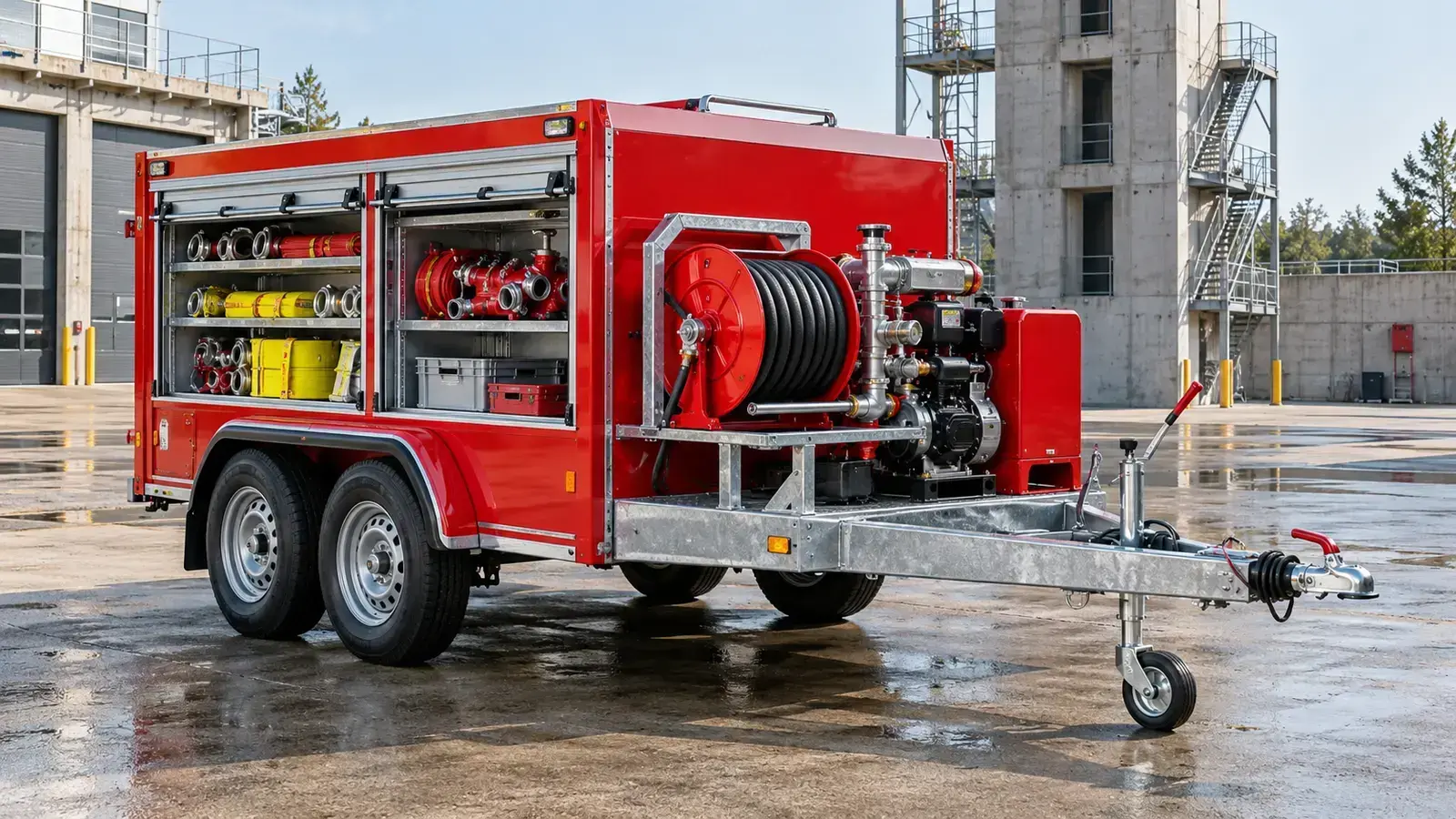
When an emergency-response team needs useful capability without dedicating a full truck to every location, a properly specified trailer can provide a flexible answer. This new custom-built Fire and Rescue Trailer is advertised as a twin-axle platform that can be configured for firefighting, rescue work or a combination of both.
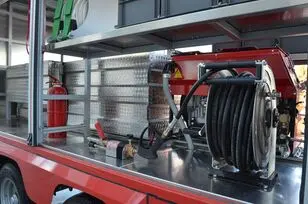
The listing says the trailer may be supplied with or without equipment. Available features include a petrol- or diesel-driven UHPS firefighting system, water and foam tanks, a hose reel and lockers for rescue equipment. That flexibility is the central attraction: the buyer can discuss a build around identified risks instead of accepting a one-size-fits-all package.
Review method: desk-based assessment of the advertiser’s description, listing data and 14 supplied photographs, verified 31 October 2026. The photographs are reproduced under the publisher’s marketplace-media permission. Worksite Safety Hub has not physically inspected, towed or operationally tested the trailer.
Quick verdict
The Fire and Rescue Trailer offers an interesting configurable foundation for organisations that want mobile water-and-foam capability, rescue-equipment storage or both. Its twin-axle layout and enclosed locker body appear designed to combine transport, protection and rapid access. The listing, however, is intentionally high-level: capacities, dimensions, weights, pump performance, road approval, included tools and delivered price require a formal quotation.
This is therefore best approached as a configurable procurement project rather than a fixed catalogue item. Buyers who begin with a documented risk assessment, response philosophy and equipment schedule will be better positioned to compare the supplier’s proposal with operational needs.
Verified specifications at a glance
| Product | Fire and Rescue Trailer |
|---|---|
| Equipment category | Firefighting and rescue equipment |
| Trailer configuration | Custom-built twin axle |
| Condition | New |
| Intended build | Firefighting, rescue or combined configuration |
| Equipment supply | Available with or without equipment |
| Firefighting system | UHPS option mentioned |
| UHPS engine | Petrol- or diesel-driven option mentioned |
| Water tank | Mentioned; capacity not specified |
| Foam tank | Mentioned; capacity not specified |
| Hose reel | Mentioned |
| Rescue lockers | Mentioned |
| Price | On request |
| Product location | Turkey |
| Delivery areas | Not specified |
| Shipping terms | Not specified |
| Listing reference | Autoline ID WV39663 |
| Listing status | Active when verified |
What is the Fire and Rescue Trailer?
A fire and rescue trailer is a towable platform built to bring emergency-response equipment to a worksite or incident area. Unlike a self-propelled fire appliance, it depends on a compatible towing vehicle. That can give an organisation flexibility to share the towing resource, stage the trailer at a remote facility or deploy it for planned activities.
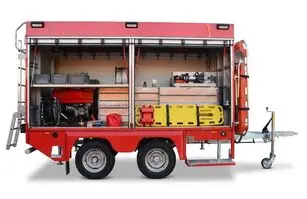
The reviewed product is described as custom built. The listing does not identify one fixed model code or universal equipment package. This matters because the visible photographs illustrate possible configurations, while the commercial offer may be tailored. A buyer should insist on a revision-controlled specification identifying the exact body, tanks, pump, power source, lockers, accessories and documents included.
Custom-built twin-axle design
Two axles can distribute load more effectively than a single-axle layout and may support stability when the trailer is properly designed, loaded and coupled. Those benefits depend on confirmed axle ratings, tyre capacities, suspension, brake system, centre of gravity and actual operating mass. Photographs alone cannot establish towing compliance.
Request the unladen mass, gross vehicle or maximum authorised mass, nose weight, overall dimensions and load distribution drawing. Confirm the coupling type, jockey wheel, stabilisers, parking brake, road lighting, electrical connector and spare-wheel provision. The intended towing vehicle must have adequate rated capacity, compatible braking and electrical connections, and suitable traction for the routes involved.
Firefighting, rescue or combined configurations
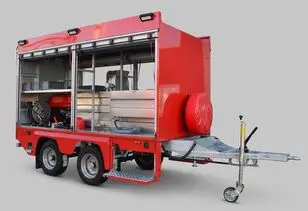
The seller explicitly offers rescue and/or firefighting trailers and says units may be supplied with or without equipment. That opens three useful procurement paths. A firefighting build can concentrate on water, foam, pump, hose and nozzle capability. A rescue build can prioritise organised storage, lighting, power and tool deployment. A combined build can carry both, but payload and space must be managed carefully.
Define the mission before selecting equipment. A remote industrial site may prioritise rapid first response and exposure protection. A municipal reserve unit may need compatibility with existing couplings and hose inventory. A rescue contractor may value secure, labelled lockers and a practical deployment sequence. Every addition affects mass, balance, maintenance and training.
Optional UHPS firefighting system
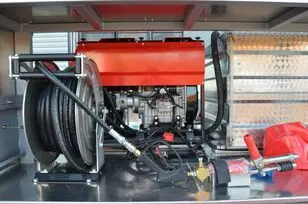
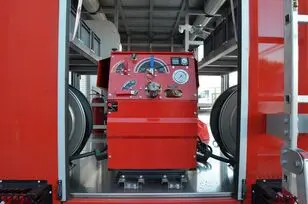
The listing says a UHPS firefighting system can be installed. UHPS generally refers to an ultra-high-pressure arrangement using a purpose-designed pump, hose and nozzle to apply water at high pressure. It may support efficient water use in an appropriately engineered application, but the listing does not publish operating pressure, flow rate, hose size or performance data.
Ask for the system manufacturer, exact model, rated pressure and flow, permitted duty cycle, priming method, pressure-relief arrangements and nozzle choices. Confirm the water source, foam compatibility, hose length, reel rewind system, freeze protection, high-temperature limits, maintenance intervals and spare-parts support. UHPS should not be assumed to replace every conventional method; its role must be defined in the organisation’s firefighting strategy.
Petrol versus diesel engine options
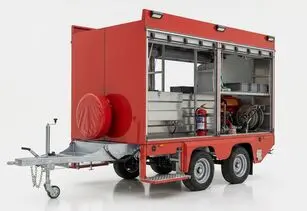
The seller mentions petrol- and diesel-driven UHPS options. Petrol engines can be compact and familiar, while diesel may align with the fuel policy of many industrial fleets. The best choice depends on site fuel availability, ventilation, starting reliability, storage controls, maintenance competence and environmental conditions.
Request engine make, model, output, fuel capacity, expected run time, starting arrangement, battery specification, exhaust routing, guarding and shutdown controls. Confirm how the system is operated when locker doors are open and what ventilation clearances are required. Include fuel inspection, periodic running, battery care and safe refuelling in the maintenance plan.
Water tank, foam tank and hose-reel arrangement
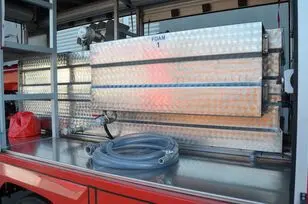
Water and foam tanks with a hose reel are mentioned, but capacities, construction materials and proportioning arrangements are not stated. Ask for usable volumes, baffle design, fill and drain points, level indication, overflow routing, cleaning access and tank mounting. Water movement can materially affect towing behaviour, so the design should address partially filled tanks and load distribution.
For foam service, identify the concentrate types the system is designed to use, the proportioning method and flushing procedure. Compatibility must be confirmed for seals, pumps, hoses, tanks and the buyer’s selected concentrate. Obtain the reel type, hose length, working pressure, nozzle options and safe deployment method. The quotation should identify every included coupling and adaptor.
Rescue-equipment lockers and storage planning
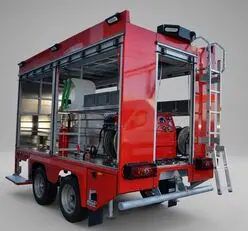
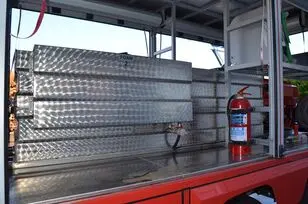
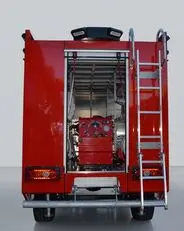
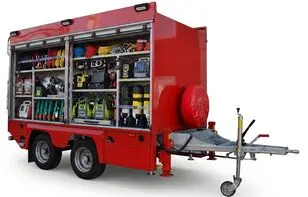
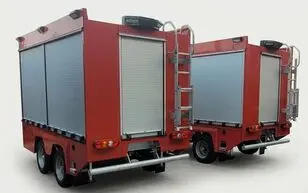
Lockers are more than empty spaces: a professional layout should protect equipment, maintain weight distribution and let responders reach priority tools without unloading unrelated items. The photographs show enclosed side compartments and possible shelving arrangements. Ask which shelves, trays, brackets, lighting and restraints are included.
Build the locker schedule around an operational sequence. Stabilisation and scene-control items may need immediate access; hydraulic or battery rescue tools require secure mounts; medical or contamination-sensitive equipment may need separation. Heavy items should be positioned to manage axle load and manual-handling risk. Every tool should have a defined location, inspection frequency and retention method.
Potential applications
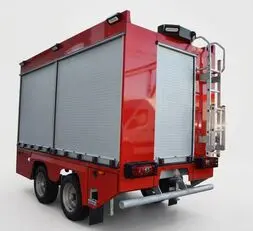
A correctly specified trailer may support industrial first response, remote worksites, construction projects, mines, quarries, warehouses, power facilities, ports, marinas, airports, agricultural operations, temporary events, municipal reserve capability, disaster-response staging and training exercises. Rescue-focused configurations may also support technical-response contractors or civil-defence organisations.
Suitability is never established by the product name alone. The final specification should follow a competent fire-risk assessment, emergency-response plan, credible incident scenarios, water-supply study and local regulatory requirements. Consider mobilisation time, towing routes, staffing, communications, personal protective equipment, water replenishment and post-incident recovery.
Trailer, towing and compatibility checks
- Overall length, width and height, including deployed doors or awnings.
- Unladen mass, maximum authorised mass, payload and permitted nose weight.
- Axle, suspension, tyre and wheel ratings.
- Brake type, breakaway system, parking brake and inspection requirements.
- Coupling height and type, safety cables or chains, jockey wheel and stabilisers.
- Road lighting, reflectors and electrical connector.
- Turning circle, ground clearance and route restrictions.
- Towing-vehicle capacity, driver licensing and registration requirements.
- Load-distribution limits with full, partial and empty tanks.
- Secure storage for hoses, tools, fuel and loose equipment.
Firefighting-system questions to verify
- Who manufactures the UHPS pump, engine, reel, hose and nozzle?
- What are the rated pressure, flow and maximum operating duration?
- Which tank capacities and construction materials are proposed?
- How is foam introduced, proportioned and flushed?
- What relief, shutdown, guarding and temperature protections are fitted?
- Can the system draft from an external source or accept hydrant supply?
- Which couplings and adaptors are included?
- What commissioning tests, manuals and operator training are provided?
- Which maintenance agents and spare parts are available at destination?
Rescue-equipment questions to verify
- Which tools, lighting, generators, hydraulic systems or battery chargers are included?
- How are heavy tools mounted and retained during travel?
- Are compartment lights, scene lights and external power connections fitted?
- What ingress-protection or weather-resistance information is available?
- How are clean, contaminated and fuel-powered items separated?
- Can shelf heights, drawers and tool boards be customised?
- What payload remains after tanks and firefighting equipment are installed?
Product location, delivery and export considerations
Listed product location: Turkey.
The reviewed listing does not specify delivery areas, freight costs, export arrangements or shipping terms. Prospective buyers should confirm transport availability, export documentation, loading arrangements, insurance, customs responsibilities and total delivered cost directly with the supplier.
Also establish whether the trailer can be registered at destination, whether type approval or an individual inspection is required, and whether lighting, brakes, coupling, dimensions and mass comply with local rules. Ask who prepares export documents, who selects the carrier, where risk transfers, and whether commissioning or training can be provided after arrival.
Current seller offer — verified 31 October 2026
The information in this section may change. The technical buyer’s guide remains useful if the displayed trailer is sold, withdrawn or reconfigured. Ask whether the photographs show the exact available unit, an example build or several possible configurations.
Buyer inspection and procurement checklist
- Issue a written operational requirement based on the risk assessment.
- Request a formal quotation and revision-controlled equipment schedule.
- Separate included, optional and buyer-supplied equipment.
- Confirm dimensions, mass, payload, axle loads and towing requirements.
- Review tank, pump, engine, hose, reel and nozzle specifications.
- Confirm brake, coupling, lighting, tyre and road-registration details.
- Review locker layout, tool restraints, access and scene lighting.
- Request drawings, manuals, certificates and test records.
- Agree factory-acceptance tests and performance demonstrations.
- Confirm training, commissioning, warranty and after-sales support.
- Calculate freight, insurance, customs, duties, taxes and destination inspection.
- Confirm manufacturing and delivery lead times in writing.
Questions to ask before contacting the seller
- Is the pictured trailer the exact unit available or an example of a custom build?
- Which equipment is included in the quoted price, and which items are optional?
- What are the water- and foam-tank capacities?
- Which UHPS make, model, pressure and flow are proposed?
- Will the quoted engine be petrol or diesel?
- Which hose, reel, nozzle, couplings and adaptors are supplied?
- Which rescue tools, shelves, brackets and restraints are included?
- What are the dimensions, unladen mass, payload and maximum authorised mass?
- What towing vehicle, coupling, brakes and electrical connector are required?
- Are stabilisers, a jockey wheel and a spare wheel included?
- Which road-registration and conformity documents are provided?
- Can the internal layout and external finish be customised?
- What are the manufacturing and commissioning lead times?
- Are operator and maintenance training available?
- What warranty and spare-parts support are provided?
- Can international shipping, loading and export documentation be arranged?
- Who carries freight, insurance, customs and import responsibilities?
- What is the total delivered price to the intended destination?
- Can the buyer inspect the exact unit or witness factory-acceptance testing?
- Can the supplier provide a current walk-around video and full technical proposal?
Original advertiser gallery
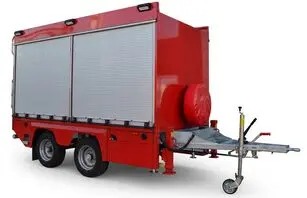
The gallery below shows the product configurations supplied with the listing. Because this is described as a custom-built offer, confirm which visible details belong to the exact quotation.
Who may find this trailer useful?
The concept may appeal to organisations needing deployable emergency-response capability without assigning a dedicated powered appliance to every location. Industrial operators, contractors, remote facilities, emergency-service support teams, training organisations and equipment-rental businesses may value the configurable body and protected storage.
The strongest procurement case exists where the organisation has clearly defined its credible scenarios, required response time, available personnel, towing resources and maintenance plan. A trailer cannot compensate for insufficient staffing, unsuitable tactics or missing water supply; it should form one planned element of a wider emergency-response system.
Final assessment
This Fire and Rescue Trailer presents a flexible, visually practical platform with twin axles, multiple equipment compartments and advertised options for UHPS firefighting, water, foam, hose storage and rescue equipment. The ability to buy it equipped, unequipped or configured for a combined mission is its most valuable feature.
The next step is specification, not assumption. Capacities, performance, payload, road compliance, included equipment and delivered cost are not published. A detailed proposal and witnessed acceptance process would allow a buyer to judge whether the final build matches the intended hazards, response team and destination rules.
Frequently asked questions
What is a Fire and Rescue Trailer?
It is a towable emergency-response platform that can carry firefighting systems, rescue equipment or a combination selected for the intended operation.
Is this trailer supplied with firefighting equipment?
The seller says it can be supplied with or without equipment. Buyers should request an itemised quotation showing exactly what is included.
Can it be configured for rescue operations?
Yes. The listing describes rescue and/or firefighting configurations and mentions lockers for rescue equipment.
What is a UHPS firefighting system?
UHPS means ultra-high-pressure system. It uses a high-pressure pump and purpose-designed hose and nozzle arrangement; the exact pressure, flow and operating limits must be confirmed for the selected build.
Is the UHPS engine petrol or diesel?
The seller states that petrol- or diesel-driven options are available. The selected engine must be identified in the quotation.
Are water and foam tanks included?
Water and foam tanks are mentioned as available equipment, but their capacities and inclusion in the quoted configuration are not stated.
What equipment is included in the advertised price?
The price is available on request and the precise included equipment is not published. Request a formal equipment schedule and quotation.
Where is the Fire and Rescue Trailer located?
The listing identifies the product location as Turkey.
Is international delivery available?
Delivery areas, freight charges and export terms are not specified in the reviewed listing. Confirm them directly with the supplier.
What towing information should buyers verify?
Confirm dimensions, unladen and maximum mass, coupling, brakes, axle ratings, tyres, lighting connector, towing-vehicle requirements and local road-registration rules.
Which documents should be requested?
Ask for the technical specification, equipment schedule, test records, road-registration documents, declarations of conformity where applicable, warranty and maintenance instructions.
How can a buyer obtain the current price?
Use the affiliate listing to request the latest price, configuration, lead time and delivered-cost quotation from the supplier.
Join the discussion
Would your organisation configure this trailer primarily for firefighting, technical rescue or a combination of both? Which equipment would be essential for your operation? Share your thoughts or questions in the comment section below.
Sources and editorial information
- Autoline listing WV39663 — description, condition, product location, commercial status and advertiser-supplied media, verified 31 October 2026.
- Worksite Safety Hub editorial analysis — procurement, towing, equipment-verification and emergency-planning guidance.
HSSE TIPS — Worksite Safety Hub
Every Task. Every Person. Home Safe.
Your experience matters
Share your thoughts on this page
Have a question, a useful experience or a suggestion? Add your input below.
Comments are public. Keep them respectful and relevant. Do not share contact details, confidential information or emergency reports.
Comments on this page
Loading comments…