Process Safety · Lesson 23 · 7 min read
The Visible Fog Is Not the Boundary of a Nitrogen Release
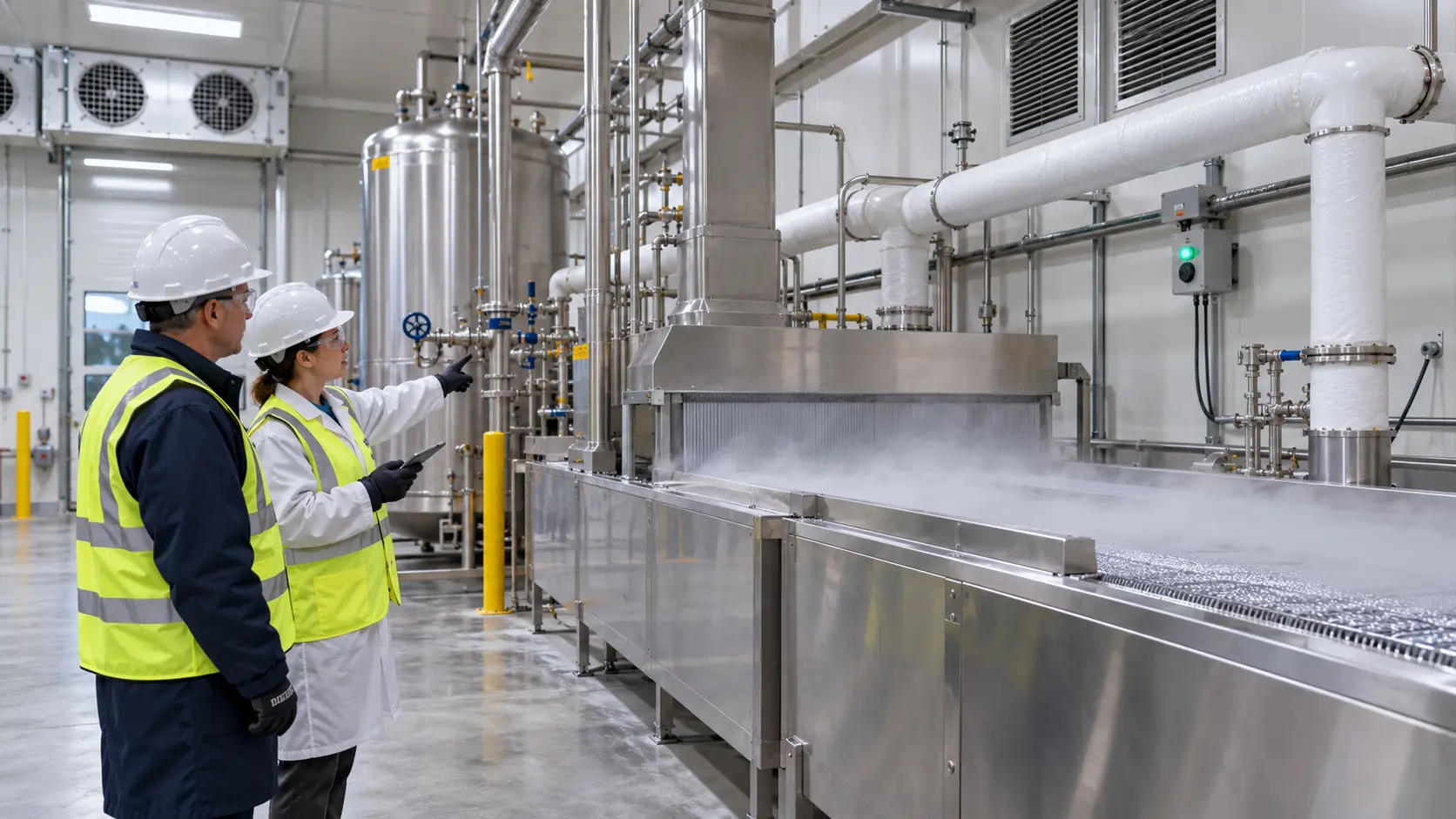
Liquid nitrogen is not flammable or toxic, but it can still create a fatal process hazard. When released, it rapidly becomes gas and displaces oxygen. The white fog sometimes seen around a cold release is condensed water vapour—not a dependable map of the oxygen-deficient atmosphere. Clear-looking air can already be unsafe.
How an invisible asphyxiation hazard develops
A cryogenic system stores nitrogen as an extremely cold liquid. A loss of containment adds a large volume of nitrogen gas to the room as the liquid warms and vaporises. In an enclosed, recessed or poorly ventilated space, that gas can accumulate faster than fresh air replaces it.
People cannot smell, taste or see nitrogen. Oxygen deprivation may impair judgment and coordination before a worker recognises danger; at lower concentrations, collapse can occur without useful warning. Cold nitrogen vapour may initially collect at low level, but mixing, ventilation patterns, equipment geometry and temperature changes can move the deficient atmosphere well beyond the visible white fog.
The controlling question is therefore not, “Can we still see the cloud?” It is, “What does a correctly located, tested oxygen-monitoring system show, and can we stop the release without entering the affected area?”
The Foundation Food Group warning
On 28 January 2021, liquid nitrogen overflowed from an immersion freezer at the Foundation Food Group poultry-processing facility in Gainesville, Georgia. The liquid rapidly vaporised and accumulated in a partially enclosed lower-level room that had no mechanical ventilation. Six workers died from asphyxiation, three employees and one firefighter were seriously injured, and others entered or approached the area during the response.
The U.S. Chemical Safety and Hazard Investigation Board (CSB) found that a bent bubbler tube caused the freezer’s level-control system to measure and control the liquid-nitrogen level incorrectly. One vulnerable measurement device could therefore lead to an uncontrolled overflow. The facility did not have fixed atmospheric monitoring and alarms capable of warning people about the developing oxygen-deficient atmosphere.
The emergency arrangements made the consequences worse. The CSB found that at least 14 employees entered the freezer room or surrounding area to investigate, isolate the equipment or attempt rescue. The available emergency-stop locations required a person to enter the hazardous atmosphere, while the workforce had not been meaningfully prepared for a liquid-nitrogen release.
Critical controls for cryogenic nitrogen systems
Apply process-safety discipline even when the chemical is not flammable. Perform a structured hazard analysis covering overflow, loss of ventilation, line or hose failure, set-point error, maintenance damage, interlock bypass, power failure and emergency isolation. Consider where gas can collect and where people may be during operation, cleaning and troubleshooting.
Do not let one instrument own the whole hazard. Where consequence warrants it, provide an independent high-level or overflow safeguard that uses a separate sensing principle and fails the nitrogen supply to a safe condition. Protect vulnerable components from maintenance damage and proof-test the complete trip path at a defined interval.
Engineer ventilation for the credible release. Natural leakage through doors is not a ventilation design. Determine the release rate, room volume, low points, partial enclosures and airflow paths. Provide normal and emergency ventilation sized and arranged to prevent dangerous accumulation, and monitor ventilation availability as a condition for operation.
Install fixed oxygen monitoring and distinctive alarms. Select detector locations using the release points and dispersion behaviour—not convenience. Alarm locally and at a continuously attended location using visible and audible signals that cannot be confused with routine process alarms. Calibrate, bump-test and function-test detectors and their alarm actions.
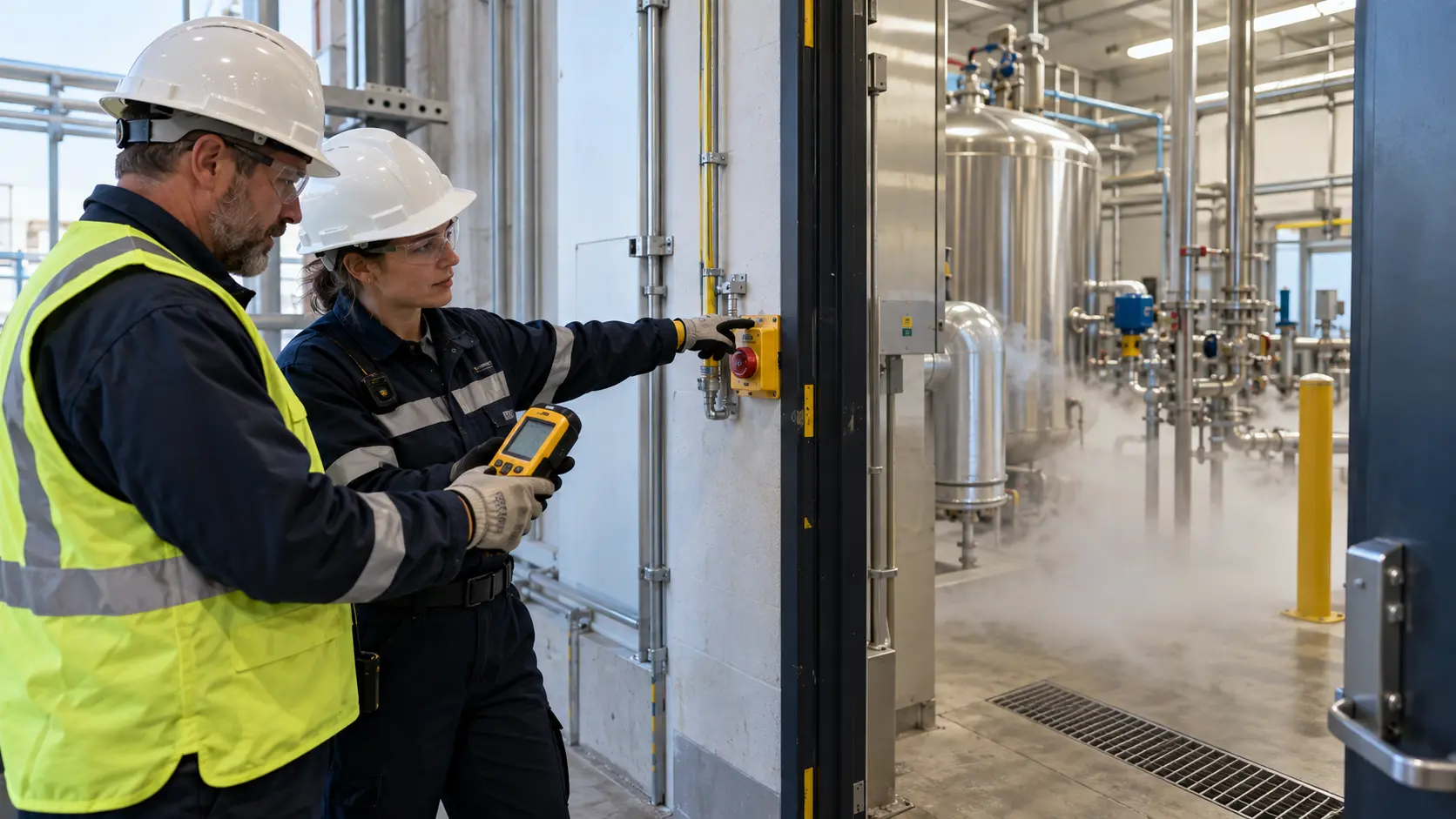
Make isolation possible from a safe place. Position emergency stops and remotely operated isolation valves outside the credible oxygen-deficient zone. Identify the safe approach route, label controls clearly and test that pressing the button actually isolates the nitrogen source. A control that can be reached only by entering the release is not an effective emergency safeguard.
Control maintenance, set-point changes and bypasses. Shut down and isolate energy before intrusive troubleshooting where practicable. Use permits and management of change for altered set points, modified logic, defeated interlocks or changes to room layout and ventilation. Restore and independently verify every safeguard before returning the process to service.
Train everyone to evacuate—not improvise a rescue. Workers, contractors and supervisors must recognise the alarm, leave by a safe route, account for personnel and prevent entry. Only trained emergency responders using suitable supplied-air respiratory protection, communications, backup and an approved rescue plan should enter an oxygen-deficient atmosphere.
Watch the official CSB investigation video
The CSB’s Fatal Fog: Liquid Nitrogen Release at Foundation Food Group, released on 25 August 2026, explains the single-point level-control failure, lack of atmospheric monitoring, inadequate emergency preparation and wider process-safety-management lessons.
A question for today’s team
If our largest credible nitrogen release occurred now, what would detect it, ventilate it and isolate it without anyone entering the oxygen-deficient area—and when was that complete protection path last tested?
Your experience matters
Share your thoughts on this page
Have a question, a useful experience or a suggestion? Add your input below.
Comments are public. Keep them respectful and relevant. Do not share contact details, confidential information or emergency reports.
Comments on this page
Loading comments…