Environmental Management · Water Protection · Biogas · Regulatory Readiness
EU Liquid Digestate Proposal: Check Before Changing Nutrient Controls
Published
Commission news: 19 October 2026 · Supporting JRC publication: 16 October 2026 · Proposal, not an adopted new permission
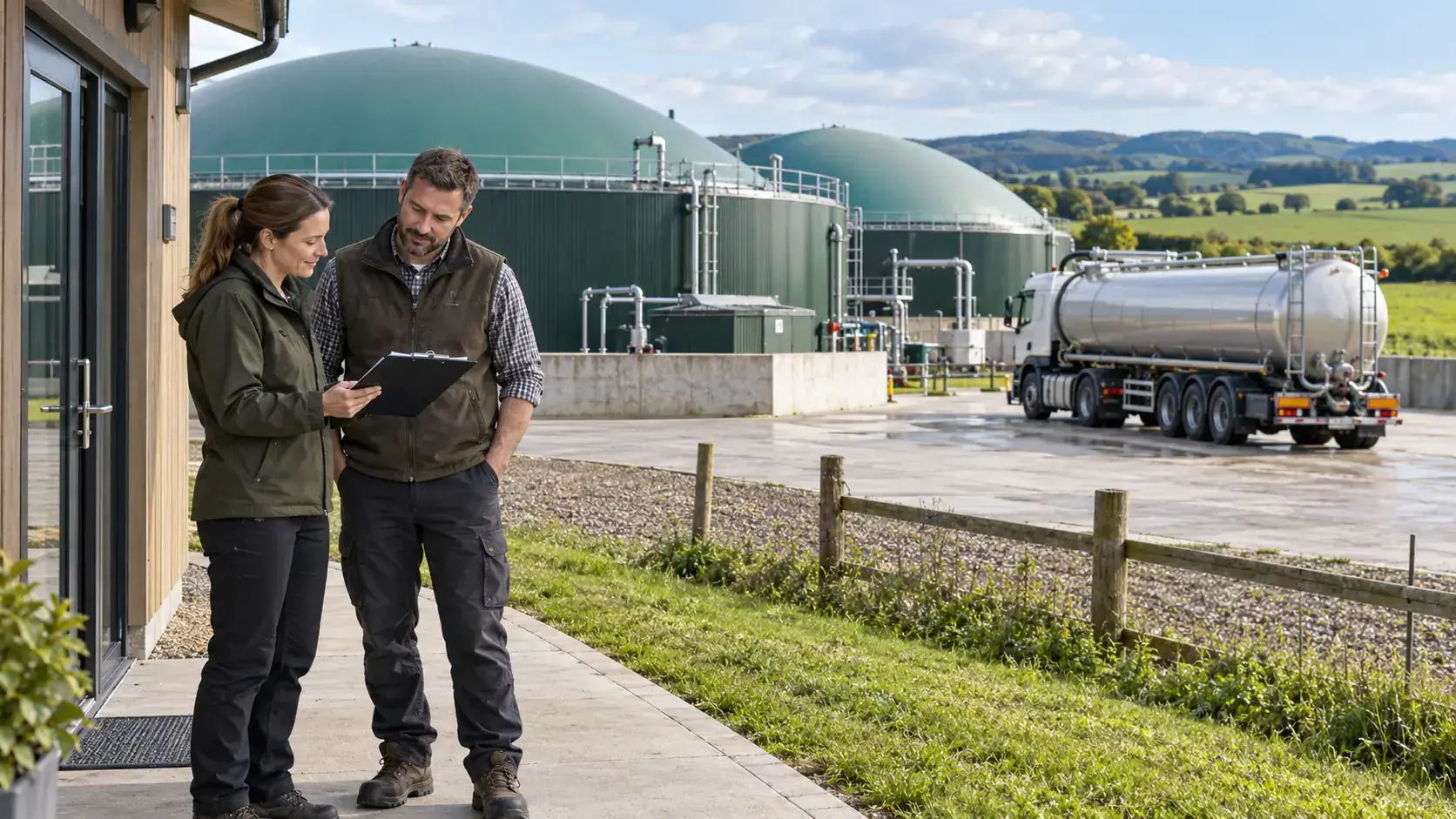
A recovered nutrient can be valuable without being automatically suitable for every field or legally exempt from existing controls. A new EU proposal gives biogas operators, farmers and environmental teams a reason to organise their evidence—not a reason to increase spreading before permission exists.
What the Commission announced
In news published on 19 October 2026, the European Commission described a proposed extension of RENURE rules ↗ to certain liquid digestates derived from livestock manure. The aim is to support substitution for chemical fertilisers while retaining environmental safeguards. Digestate is the material remaining after anaerobic digestion for biogas or biomethane production.
This is a proposal, not a blanket permission already in force. The announcement describes public feedback, consideration by Member States in the Nitrates Committee, and subsequent European Parliament and Council scrutiny before possible adoption. It does not establish that every digestate qualifies, that every Member State will authorise it or that a particular site may change its current nutrient limits.
The publication date above is the news announcement date. Check the official consultation portal ↗ for the operative draft and timetable; this article does not infer a consultation deadline or promise an effective date.
What is—and is not—being proposed
RENURE means recovered nitrogen from manure. An earlier 2026 amendment created an optional route for Member States to authorise specified recovered materials, with conditions. The new announcement concerns extending the approach to certain liquid fractions, not all solid or liquid digestates or all anaerobic-digestion outputs.
A potential change in nutrient-accounting treatment should not be assumed to settle every other legal question. Check the applicable national rules, environmental permits and material-specific obligations with competent advisers. Do not infer a change to waste, product, animal-by-product or site-operating requirements merely from this announcement.
Why quality and field conditions remain central
The supporting JRC publication record, dated 16 October 2026 ↗, explains that digestate performance depends on feedstock, processing, storage and local conditions. It identifies risks including ammonia emissions, nitrate leaching, nutrient imbalances, contaminants and persistent pathogens. Its abstract stresses that not all digestates meet relevant criteria.
The Commission’s existing nitrates guidance ↗ also connects nutrient use with crop demand, vulnerable waters, suitable application conditions and sufficient storage. A circular-economy label does not remove those environmental relationships.
Practical review 1: identify the actual material
The following are Worksite Safety Hub readiness questions, not additional conditions attributed to an unadopted draft. Build a material record linking feedstocks, treatment and separation steps, representative analysis, storage history and the intended use. Establish how changes in inputs or processing trigger reassessment.
Ask the competent technical team which properties and contaminants need assessment for that material and destination. Confirm sampling methods, laboratory competence and the relevance of results to the batch supplied. Do not use a generic analysis or another producer’s declaration as proof of your material’s eligibility.
Practical review 2: keep nutrient planning tied to the receiving land
Before changing a plan, verify the current authorisation, crop requirements, soil information, other nutrient inputs and receiving-field constraints. Name the person who decides whether a load can be accepted and how that decision reaches the contractor doing the work.
Review application timing, weather, field condition and water-protection restrictions under the rules that actually apply. Retain the ability to defer spreading safely. A pressure to empty storage is not evidence that land application is acceptable.
Practical review 3: check storage and transfer interfaces
Walk the material’s path from production to its final destination. Check inspection arrangements for storage, transfer points, hoses, connections and vehicle movements. Establish how leaks are detected, contained and reported, and ensure contractors know which equipment and emergency arrangements apply.
Keep worker-safety controls in place independently of any fertiliser-policy change. Do not open or enter tanks, improvise sampling access or attempt a rescue without the required competent planning and confined-space arrangements. An environmental-policy proposal is not an operating method.
Practical review 4: use controlled change, not an early assumption
Assign one owner to track the official proposal, assess implications and brief purchasing, operations and contractors. Record the difference between proposed eligibility, adopted requirements, national implementation and a site-specific permission.
Update specifications or nutrient plans only after the applicable position is established and authorised. If making a consultation response, use operational evidence about material variability, monitoring and practical pollution controls. Avoid claiming that a draft will guarantee cost savings or environmental performance at every facility.
Leadership and toolbox questions
- Which exact liquid fraction, feedstock and treatment does our evidence describe?
- What current rule authorises the intended use at the receiving location?
- Can the operator postpone application without creating a storage problem?
- Who checks the handover between producer, transporter, adviser and farmer?
- What would make us reject or reassess a material, load or spreading plan?
Video note
No directly relevant authoritative video with a verified publisher, title and embeddable URL was found for the new proposal. Promotional biogas footage and older general explainers have not been inserted as regulatory evidence.
Primary sources and dates
- European Commission — Proposed flexibility for certain liquid digestates ↗News published 19 October 2026. Describes a draft amendment, public feedback and further approval and scrutiny stages—not a new blanket exemption in force.
- European Commission — Have Your Say: recovered nitrogen from manure ↗Official consultation route linked by the announcement. Check the live portal for the draft, current timetable and participation arrangements; no closing date is inferred here.
- JRC — Safe application of agricultural digestates under various conditions ↗Publication record dated 16 October 2026, JRC147838. The public abstract describes variability, nutrient losses and the need for quality criteria and safeguards.
- European Commission — Nitrates: current framework and water-protection principles ↗Existing framework, checked 19 October 2026. Discusses vulnerable zones, crop need, spreading restrictions and storage. The page contains an apparent year typo in its consultation chronology; this article relies on the separately dated news release for the new announcement.
- European Commission — Earlier RENURE amendment ↗Published 9 February 2026. Distinguishes the earlier adopted framework from the new proposed extension; national authorisation and implementation matter.
Sources checked 19 October 2026. Confirmed source statements, preliminary or proposed developments and original practical applications are distinguished above. Always check current official status and applicable local requirements.
Share the lesson
Open the separate 9:16 Pinterest poster
This original AI-generated poster is illustrative, not an image of an actual incident, named site or approved installation. HSSE TIPS branding appears only in its designed footer area.
Your experience matters
Share your thoughts on this page
Have a question, a useful experience or a suggestion? Add your input below.
Comments are public. Keep them respectful and relevant. Do not share contact details, confidential information or emergency reports.
Comments on this page
Loading comments…