Industrial-Truck Battery Charging and Hydrogen Control
The Forklift Is Parked, but the Battery Hazard Is Active
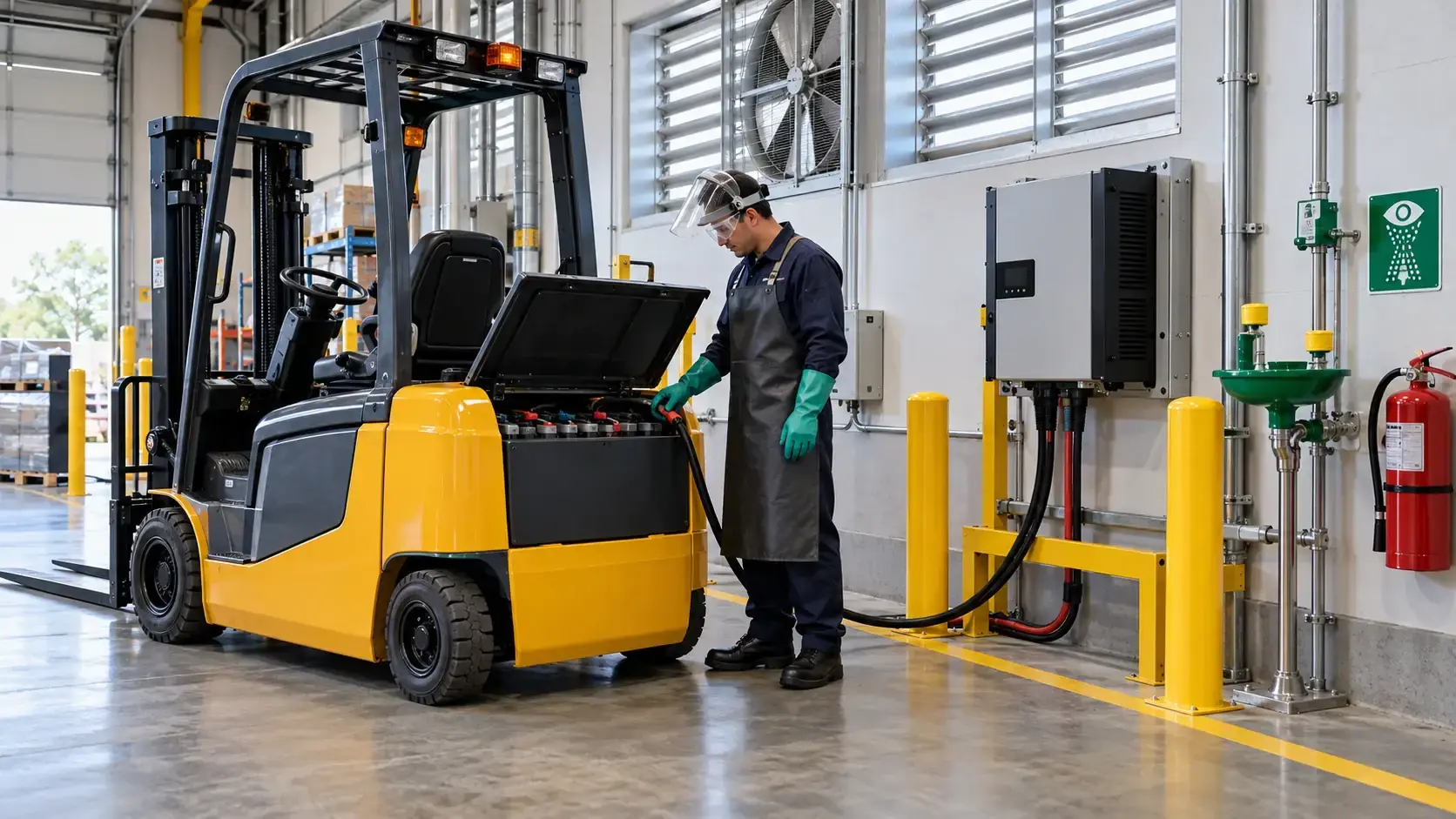
A charging industrial-truck battery may look quiet, but the work can involve corrosive electrolyte, electrical short-circuit energy and hydrogen that becomes explosive if it accumulates. Treat charging as a controlled task in a designated area—not as parking beside a socket. Position the truck safely, control ignition sources, provide effective ventilation and confirm emergency equipment before connecting the charger. The truck may be stationary, but the battery hazard is active.
Controls to confirm
- Charge only in the designated area. Correctly position the truck, apply the brake, inspect the charger and leads, protect charging equipment from vehicle impact and follow the manufacturer and site procedure for connecting, operating and disconnecting the charger.
- Keep the area adequately ventilated and the battery cover or compartment open where the procedure requires it so heat and hydrogen can disperse. Prohibit smoking, flames, sparks and electrical arcs, and keep jewellery, tools and other metallic objects away from uncovered battery terminals.
- Allow only trained workers to charge or change batteries. Provide the specified eye, face, hand and body protection, and confirm that suitable flushing, spill-neutralisation and fire-protection equipment is immediately available; use approved handling equipment and secure any battery that is removed and reinstalled.
Today’s action
Before the next industrial-truck battery charge, inspect the designated station with the operator. Confirm the brake, charger condition, ventilation, ignition control, protective equipment and emergency flushing and fire-protection arrangements before power is connected.
Source guidance
Future HSSE email updates
Register interest in HSSE email updates.
Record your interest in future Worksite Safety Hub messages, selected HSSE news and new-resource alerts. Email delivery is not connected yet.
Your experience matters
Share your thoughts on this page
Have a question, a useful experience or a suggestion? Add your input below.
Comments are public. Keep them respectful and relevant. Do not share contact details, confidential information or emergency reports.
Comments on this page
Loading comments…